Showing posts with label MILANO. Show all posts

Monday, 12 January 2015

Milan Times

A short video from Milano 
(c) Bea Spolidoro - September 2013 

It is official: my city, Milan, has been selected to be the 1st place you have to visit in 2015. According to the New York Times, 52 "once-avoided destinations become must-sees and familiar cities offers new reasons to visit". In a world ruled for years by systems too big to fail, it is now the golden age of the underdogs (after the big systems failed indeed). I smile thinking that my city is the first of the once-avoided destinations. Truth, after the excitement of discovering I am Italian, people are a bit perplexed still now, when I tell them I am from "Milano". Then I underscore that I am from the very center of Milan, like 10 minutes walking from the Duomo, pretending I didn't notice their bafflement.
Sunday morning I opened the NYT and I could recognize, even without wearing my glasses, the familiar shape of the guglie, the gorgeous gothic pinnacles of the Duomo. For me, it was indeed what we Italian describe as a "dive of the hearth", a mixed sense of nostalgia and happiness, that makes you feel as if your hearth is diving into a pool. 

(c) Bea Spolidoro

I started reading the article, which was a serie of recommendations for tourists spending 36 hours in Milan. Quite a big leap from the typical 36 minutes spent at the Milanese airport only, waiting for the following flight. This year is special, though, for the next EXPO will be hosted here. The theme is food and "feeding the planet". As a comedian noticed some years ago, this is typical of people from Milan: we always think bigger...

Back to the NYT: "Twenty million visitors are expected to visit the city for the Expo, a mammoth event that runs from May through October and involves more than 130 participating nations and organizations sponsoring more than 60 pavilions. The Expo’s theme focuses on food, nutrition and sustainability practices — a fitting choice for a city steeped in Italian culinary traditions."

The related article starts with a video in Italian with subtitles, in which some people are describing the city. In the opening, a man sincerely states that Milan is not a touristic city: it is an Italian city,  "founded for work, industry". That is pretty much what I always say as well, and it usually sounds like a threat. After years of saying that, I am convinced it is just a way to protect our city from the tourists, so that we can keep working smoothly. Nevertheless, Milan is indeed a wonderful city. It deserves to be visited. 
Milan it is not only shopping, food, design, industry, fashion... Milan is a very attractive city, from an architectonic point of view. There is only one thing that some people might regret: the presence of nature is very sporadic, but when you can find a green spot, it is indeed a wonderful garden, able to compete with the Japanese ones. The rest of the city is an architectonic manifestation of how 50 shades of gray could look - and I am thinking of concrete tonalities! 

As an architect, and a big supporter of my city, I don't want people to visit Milan only for what the NYT selects. Out of 11 items, 6 are about food and drinks, 2 about shopping, and only 3 items are about museums or churches, carefully surrounded by places that sells food and drinks.
I will split the article in two part: first the history, then my recommendations.
This will be a semi-serious version of Milan, with some carefully selected historic facts and some partisan explanations of why Milan is how it looks like today. Or as we say in Milan, why Milan is a big Milan. This is not a scientific article, but if you happen to be in Milan for 36 hours, you'd better follow my recommendations. 


BRIEF HISTORY OF MILAN

Milan was founded by Celts, which were not exactly friendly barbarians, and left in us a sort of atavic grumpiness that you'll have to face, soon or later in Milan.
There are different explanations for the name of the city. One version says someone recognized that the only noticeable feature of the place was to be "in-the-middle-of-the-land" (written Medio-lanum). Another version, this legendary, says that, after a war, people found a boar with "medium-length hair" (also written Medio-lanum) on the site. That was the sign to found a sanctuary, around which Milan arose. 

(c) www.storiadimilano.it

Milan has always suffered from having a poor weather in a very sunny country. The natural activity in such a place was, since the beginning, working a lot - possibly indoor. 
While Ancient Romans were conquering even sunnier places around the Mediterranean, Milan was already working in a frantic way, likely creating what can be considered a primitive form of pollution.
During the Middle Ages, Federico Barbarossa conquered Milan, arriving from places that had a weather even worse than Milan. All in all, he couldn't complain and remained and adapted to the Milanese work-life balance. 

image from www.ilgiorno.it 

In 1386, the Cathedral of the city was started. The famous Duomo di Milano, despite the prodigious Milanese efficiency, was said to be never finished, due to continuous changes. Some would say it was just because the Milanese fashion was changing so quickly, that the building couldn't keep up with the following fashion season.

In the Renaissance, Milan was flourishing thanks to commerce, and the Duke of the city Ludovico Maria Sforza invited some great Tuscan artists, like Leonardo da Vinci. Milan was the only city that asked Leonardo to do something practical, like war machines or hydraulic masterpieces and very complex dams. The few drawings Leonardo made in Milan where likely sold to make profitable investments. The rest was stolen by the French army, which made way better use of the masterpieces. We still have the Last Supper, firmly attached to a big wall.


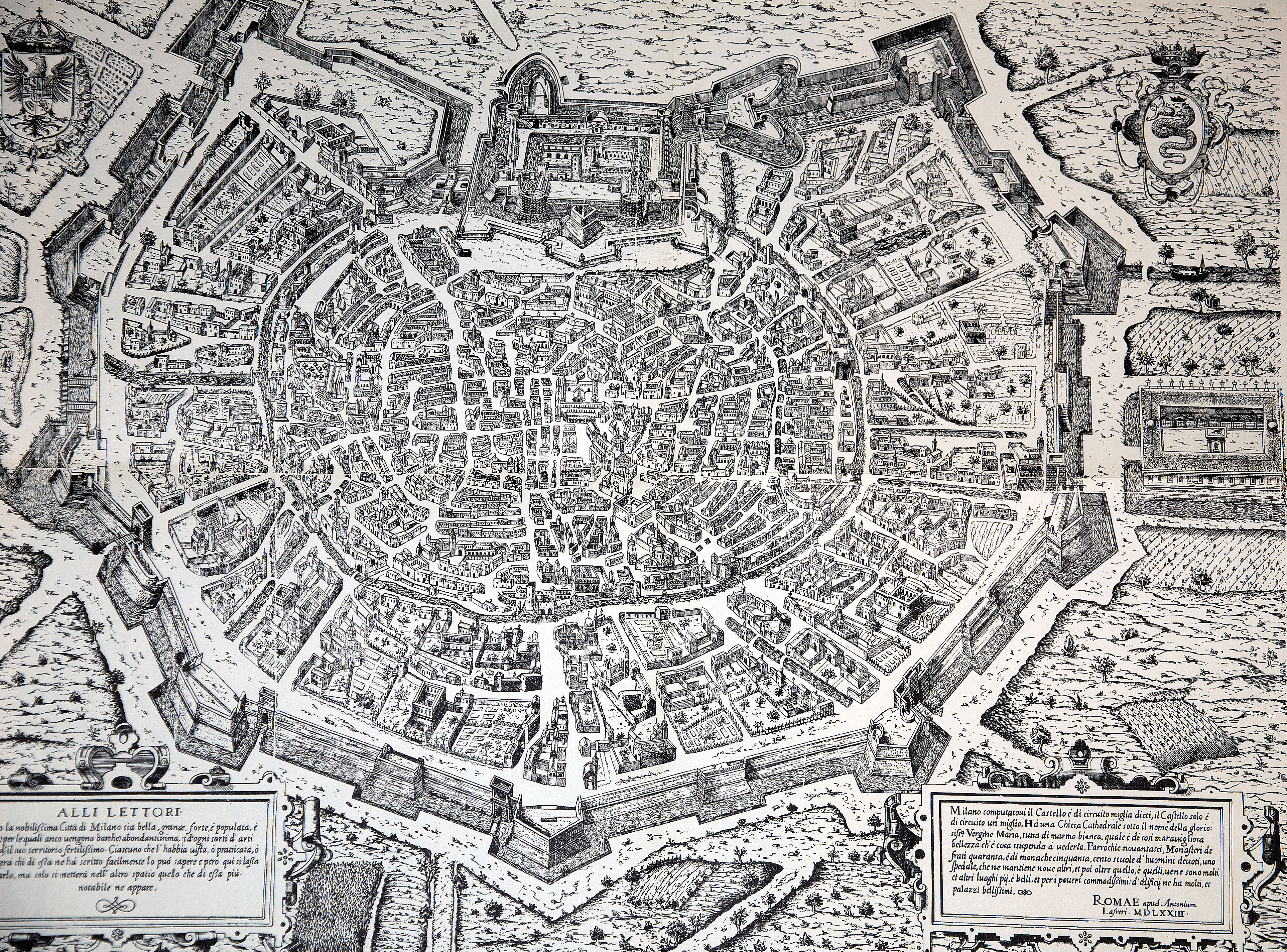
Between the 16th century and 19th Centuries France, Spain and Austria conquered Milan, building many Bastions that started eroding the little vegetation Milan was trying to preserve. 
Milan in 1573. Image from wikipedia

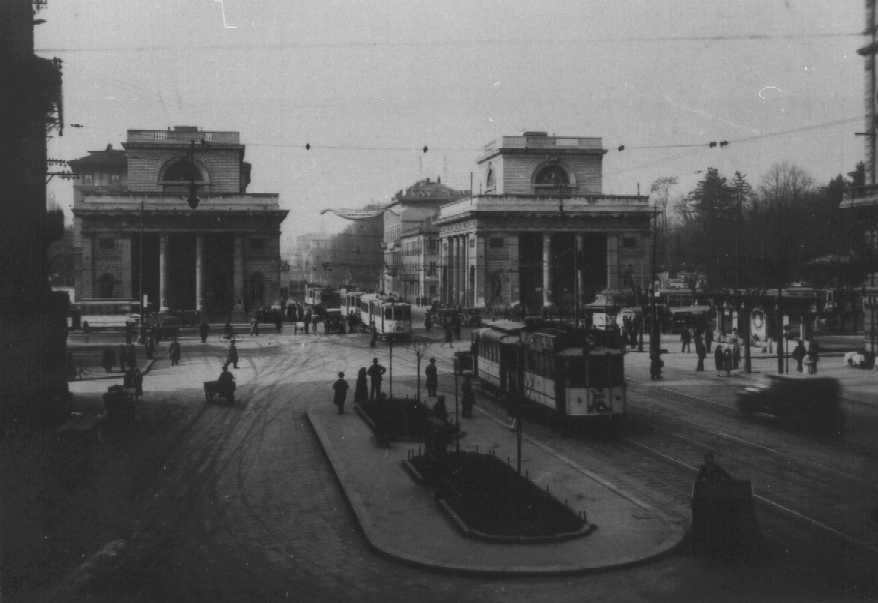
The Bastions, though, were beautiful, and Milanese started enjoying their presence. Once there was no more danger of invasions, the city kept the Bastions and turned them into passeggiate.

image from www.msacerdoti.it


The 20th Century saw Milan as the richest and most productive city in Italy. Not the biggest, even if many people from the south of Italy migrated here, looking for jobs. In 1943, during the Second World War, Milan was heavily bombed. Period.


Above, Galleria Vittorio Emanuele

Above, Santa Maria alle Grazie. This church still guests the Da Vinci's Last Supper 

Milan, together with the rest of Italy, got back on track as soon as possible. There was the economic boom in the 60s and the city grew even more. In the 80s, though, the production relented, and many industries relocated elsewhere. Milan slowed down, both economically and morally. These are the years of the Dolce Vita Milanese, and despite that sounds good now, the city didn't give its best.

After two decades of relative immobility, the New Millenium saw Milan getting a bit better, leading the industrial design sector, keeping the role of Italian fashion capital, and inventing the Happy Hour. The city, which has always a relatively poor weather, is still polluted, but less than in the past. 

Despite all the irony I put in this post, I think Milan is a truly precious city. I love it, so full of complex relation between old and new buildings. The density of the city is incredible, so full of overlapped details.
When I left the city in 2012, many of the buildings designed for the EXPO 2015 were under construction, including the famous Bosco Verticale by Stefano Boeri, voted the most beautiful highrise


Here you can see more photos I took in summer 2013. 


BEA'S RECOMMENDATIONS 

For Architecture lovers, I love these tours of the city (architecture).
The best events, daily (sorry, it's in Italian!)


Duomo di Milano and Galleria Vittorio Emanuele


Colonne di San Lorenzo and then Happy Hour in one of the many cafes

Triennale di Milano and Parco Sempione

Museo del Design alla Triennale di Milano


Teatro alla Scala and Via Manzoni


Stazione Centrale and Grattacielo Pirelli from the street

Castello Sforzesco and Museo del Castello Sforzesco

Galleria Vittorio Emanuele and Libreria Bocca


Every time I go back home, I try to see them all.
I will not recommend places to eat or drink, because once there, you'll figure out them yourself.
Have fun in Milan! But bring an umbrella, just in case... and some work to do when you are not enjoying the city.


Monday, 16 September 2013

Porto Poetic - Triennale di Milano


(...) Horizontal volumes from which, with a big effort,
you can spot a detail.
From those volumes, complex protuberances are emerging:
chimneys made bigger by the smoke,
poles, vertical partitions,
tiny units and with different heights which cut out
the lines of the roofs.
Attics, shirts hanging on ropes to get dry,
inclined roofs, cruxes, lights, palms (...) 

This is the city. There are no walls to contain it. 
But electrical cables, and the railway over granitic cubes
are connecting houses and spaces.
Just like a Pointillist painting.

Living in the beauty is necessary.
Recognizing it, not to get lost.
And yet, it remains there
- for the eyes that can see it.

Alvaro Siza on Gabriele Basilico's photograpy


I was in Portugal three times, with only a mission: to search for the Poetry of the so-called School of Porto. Fernando Tavora, Alvaro Siza, Eduardo Souto de Moura are the greatest names of this School, which has no classrooms, but a unique big University: Portugal. If anything, Light, Sky, Nature, Shadows and the City are the Professors. 

There is no need to add drama: what I am saying is just what you can see by visiting the exposition at the Triennale di Milano. "Porto Poetic" is the best place (out of Portugal) to get the idea of what I am talking about.
Apart from the great photos by famous photographers (Basilico among many others, like Chiaramonte, Mimmo Jodice) you'll be able to see technical drawing, video-interviews and wonderful wooden maquettes to explore the projects.


The School of Porto is a great example of care: for the city, for the building itself, for the people that will live in. This care is expressed also in the maniacal attention paid to the details. Even the furniture is been studied with elegance and designed to be integrated with the spaces.

Alvaro Siza always designed wonderful pieces of furniture, playing with elegance (yes, he can).
Clean lines, strong pace, a defined rhythm in every part of the designed body. But you'll remain surprised by the big gap between Siza's sketches (very dramatic and rich of overlapped traces) and his technical drawings. 

Eduardo Souto de Moura's sketches are more geometric and clear, apparently more faithful to the final result. Francesco Dal Co, during the launch of the exhibit, said that this is due because of a different point of view on the world, by the two architects.
Yet, despite the differences in the works (and sketches) of the two architects -which are good friends and worked a lot together- you can always see the Poetry of Porto, emerging.

The School of Porto, with no Manifesto nor dogmas, has always been able to decline different ideas in different ways, on a common ground: the sincerity. This term -sincerity- has been really critical in all the European theory of architecture, so far. We are obsessed with history, truth, purity and sincerity (of architecture). 
The biggest lesson of the School of Porto, by the way, is just this: there are no lectures to attend. Just open your eyes, hears and heart to the city. Sincerity, so intended, is ethically beautiful.
If you want to find the Beauty, just look at the city around you. Listen to it. See it.

Living in the beauty is necessary.
Recognizing it, not to get lost.
And yet, it remains there
- for the eyes that can see it.


Saturday, 14 September 2013

Wonder as an exercise - Triennale di Milano


Space, structure, movement and sound. Push the button and see what happens. At the Triennale di Milano it is now possible to see a special exhibition that collects 150 works by students from the Accademia di Architettura USI, realized between 2010 and 2013 at the atelier of Professor Riccardo Blumer.
The following photos refer to the exploration of the architecture of the movement, or the movement of architecture - as you please. Many other works are displayed, trying to capture the truth of architecture. According to Riccardo Blumer, the truth can be found in the Nature as well in the architecture, since it modifies the Nature. 
Wonder is the best tool to get closer and closer to the truth, exercising our eyes, brains and hearths to perceive the World deeper and more sincerely.

The wooden structure containing the machines

One side of the big wooden structure. All the wooden structures are slowingly moving and creating sound, once you push one of three buttons. 


Friday, 13 September 2013

Souto-sopra, ma Siza soprattutto

This Italian title is just a joke that I cannot directly translate to English.
I am talking about Alvaro Siza and Eduardo Souto de Moura

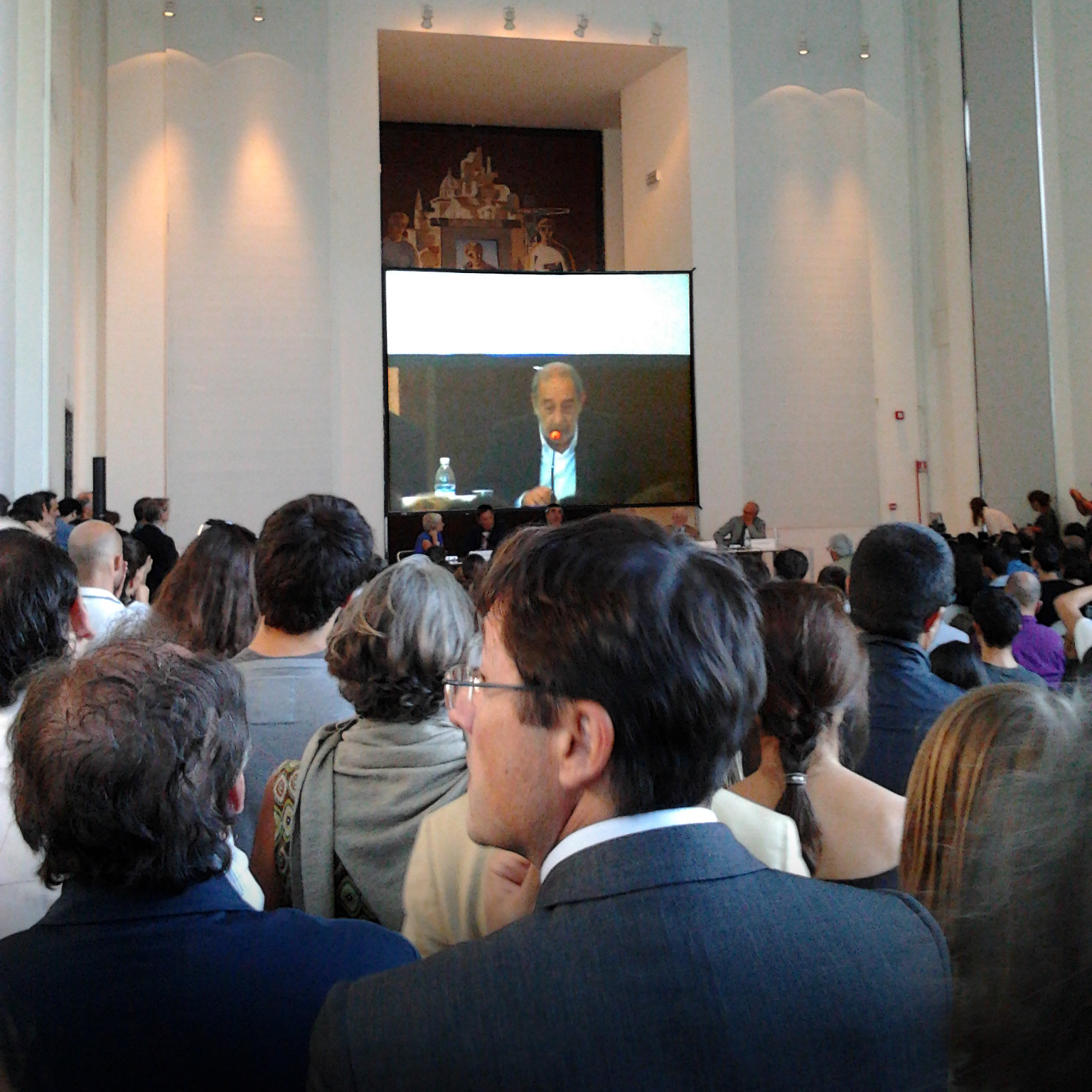
Yesterday I attended a very dense lecture, at the Triennale di Milano, with both of them on the stage, talking to many many people there.
Vittorio Gregotti was there as well, as an architect, writer and critic of architecture, and most of all friend of both Siza and Souto de Moura. 


Multiply those guys by 4.  Then,
 there was the additional room with the projection of the lecture.
It was full also that one.

Despite having to stand all the time, because of the big crowd that flooded the room, I felt very lucky to be in the same room with the two biggest Portuguese architects. 


Their work can be described with these words: a poetry of cement and light.
In fact, that lecture was organized for the opening of Porto Poetic, the newest exhibition at the Triennale di Milano. I'll write about that in few days.

For now, I can leave you with another joke, but for English-speaking architects: 
Super-Siza me!


Tuesday, 4 June 2013

My Milano


Have you ever been to Milan?
click here to see what's going on


Tuesday, 28 May 2013

Milan Updates #2


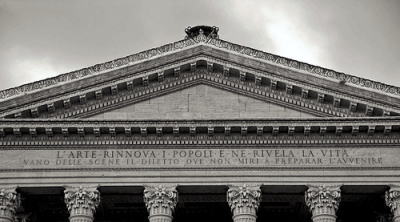
<< L'arte rinnova i popoli e ne rivela la vita >>. Philippe Daverio ce la insegna (l'Arte)


<< Art renews populations, and can disclose their lives >>


This the translation for the quote appearing on the Teatro Massimo Vittorio Emanuele in Palermo, Sicily. Given this task for Art, we now need Philippe Daverio to explain Art to us.

Philippe Daverio is, according to a definition by himself, a jacobin rebel of culture and art, deeply convinced that each population is the product of their own cultural and historical heritage. He is a great lover of Italy, plus being a mix of France, Germany and Italy. Having studied art, history, economics and politics for all his life, he is now in a position of understanding even a complex country like Italy. And he can explain to us Italian why we are as we are.

The easiest definition for him, by the way, is as follows: he is into Art. 
And this should be really intended in a physical way, because he IS indeed INTO Art. He has the ability to see it, understand it as no one else, and then share it with the masses. He is a collector, a show-man, an art merchant, an historian. He is a man of the Renaissance, and every time I listen to him or watch his tv show PasspARTtout I get more and more convinced that we can still give to us Italians another chance. At least from a cultural point of view. Even today.

Last week there was a conference, quite private let's say, in a Milanese school. He talked of Italy and of the current political, social and cultural situation. Take notes during his lectures is rather difficult, because you find yourself in a cultural hurricane of quotes, book, movies, facts. I did my best, totally captured by his charming and funny voice and his brilliance. 

I would like to share with you the most important lesson I learned from the lecture: we Italians need to renew our approach to our artistic heritage.
We must understand it and get convinced that the solution to our current problems is in our roots. We are a mix of populations, that invaded Italy during the centuries and made us so special and different, from mile to mile. Daverio made a comparison between cultura and coltura, that's culture and cultivation. Culture should be cultivated and then harvested, as we do for produce. Of course, cultivating culture in Italy, right now, is really difficult. The dryness of our Institutions and of the majority of people makes it a loosing investment, from the beginning. Indeed, that's the only solution for us. Daverio cannot stand the idea that, in a future, Italy will merely be a cultural amusement park. He would rather destroy everything, instead of seeing us frosted in our artistic heritage, simply getting money from the tourists. 
We do need to cultivate our heritage and keep producing new pieces, to make us again a creative country. 

Thus, he talked about some possible approaches to the cultivation, analyzing approaches from the Illuminism and from the Romanticism. 

<< Art renews populations >> but then we have to give an address to the culture. The Illuminism brought up ideas such as << we will give them not what they want, but what they need >>. Very dangerous approach than led also to Nazism.
Romanticism gave us the idea that << the Man is a god while he is dreaming, but just a miserable when he think about that >> (Friedrich Hölderlin). A partial solution again not correct, since the Man that would stop thinking (to dream) will rarely get good results. 

The solution is going back to the idea of society by Carl Marx, that was intended as family + religion + culture. What we need now is understand our cultural roots: preserving them and then let them flourish again, bringing new life, new culture.
After the terrible mistakes of the Nazism, when culture was used to twist the population and diffuse wrong ideas, institutions like the "Department of Cultural Heritage" have been always seen as a delicate matter, not to be given that much power. But we do need to empower that, giving it a relevant position in our Government, avoiding cuts and creating a Department able to guide an harvesting of our heritage. Finding new thoughts, new arts, new ways to make it worth-preserving: that is up to us. We cannot just leave it there, for the next tourists. We can solve a lot of problems now, by looking back and understanding our history.

Daverio is optimistic because he knows that we are a weird country, but we do know how to metabolize our cultural heritage. We have always found a way to include the old in the new construction. 
E.g Ponte Vecchio ("old bridge") in Florence: instead of being demolished, was enriched with new functions and increments (Vasari, 1565). Paris destroyed a bridge and made the one that is now called Pont Neuf ("new bridge", 1578).

In the recent years, this task of metabolization is getting more difficult and the results less convincing even in Italy. But it's the time to do that again. 
Because we are the Country of the Ponte Vecchio, that thinks of the future.


Wednesday, 22 May 2013

Milan Updates #1


Photo taken at Zara in Corso Vittorio Emanuele, Milano.
It's a piece made out of plastic, material supposed to live "forever" in the environment.
This could be a problem, when plastic is left as garbage everywhere.
But could be better used to create a piece of art that could live "forever" also in our culture.

Curated by galleria Rossana Orlandi
Installation by Hagar Fletcher 

Thursday, 12 April 2012

THE "STARCK" TRUTH


second attempt of post, I hope this could be more clear.

I was quite surprised to see the deep face of Philippe Starck on the cover of "IO donna" (easily translated: "I woman" - a STRONG stance nowadays…) last Saturday. This magazine usually talks about fashion and lifestyle, but the Milan Design Week is very close. It's like everybody suddenly MUST talk about it...

The first peculiar thing was that Mr Starck is standing on a evident Karim Rashid pink background, a color that can be compared to the more famous "Blue Klein". And he was carrying a baby. His fourth baby, a girl called Justice. 


Rewind button: I want to explain you FIRST why I'm "studying" this man.
He his a famous designer and I've always looked at his production with curiosity but respecting a kind of safe zone. He is very controversial and not always approvable. This always prevented me from going crazy for his stuff, personally selecting my (few) favorites Starck creations, still not being convinced by the utility/coolness of a gun shape lamp.


Then I discovered a BBC serie called "Design for life", transmitted in Italy from January 2012 (but originally registered in 2009) that seemed to be very interesting.
< Design For Life follows the fortunes of 12 British design students as they battle it out to impress the enfant terrible of product design, Philippe Starck.> They moved to Paris and tried a lot to impress him, but in the end it was quite a failure and I really saw little creativity (from the youngsters side) and a lot of hysteria (from Starks' one). 

And finally I read the article, on "IO donna", where I was given the opportunity to analyze him again. 
The journalist tried to talk about Starck latest creations for the Design Week in Milan, but he suddenly stopped the journalist talking about more interesting things. You can find here the Italian interview. 


<The only possible future for the Design world is in heading for dematerialization.> A strong thought, I thought.  <More with less: this is what we must work for. Like the computers; they were first big as a building, but now they are smaller and smaller, as technology allows that> And then my favorite part:
<The destiny of the designers is producing services, not objects. We need actions, no more products>. The Western Economy is slowing down and Starck says: <no surprise for this, we already knew!>. <I would like to take distance from the materiality and to focus on action.> 

In the previous post I was too concentrated on my own ideas and forgot to go deepen in the research. Then "Anonymous" reproached me, and he/she was right. I'll try to explain myself better, again. 

1) I recognize the necessity to reduce the massive production typical of the Postmodernism. There is plenty of books talking about the proliferation of Images and of fake needs.

2) I appreciate Starck's idea of focusing on the design of actions, that means: organize the processes and find a way to manage people and resources already existing. I don't expect that a traditional designer should find solutions for a better humanity. It's evident that you cannot design a "process" in the same way you design a chair. This is not the kind of design to be presented in Milan.

3) I don't want to play the role of the designer, since I'm not. I'm keen on a lot of things, design is one of those, but it's not my primary interest nor competence.

4) I think that it could be useful to start thinking of a "design of the awareness", even if this should be a personal (and interior) design, to be done first on ourselves. As Anonimous said: <awareness may also mean that architects simply stop acting like designers> and I completely agree with him/her. The world is full of people doing others job (and others business).

5) I don't think I present myself as an auctoritas. If you read my blog you will find only advice on how to spend a good Sunday, not how to manage your life. 

Finally, the most important thing. I was interested by the interview, but did not went to check what Starck is going to present in Milan.
In the past, he contributed to augment the above-mentioned massive production of objects and stuff not always useful. We could say, he was really in the system. He even acted like an archi-star, that's true.
After reading the interview I thought that maybe something was changing. On "IO Donna" you  can read that the fourth child completely changed him, so... let's give him a try - I thought.

Anonimous was scandalized by the fact that he's going to present the new Kartell collection with Lenny Kravitz: "Yeah, that Lenny Kravitz".
Well, I didn't know there are others Lenny Kravitz, but I was more impressed by the kind of chair he's going to present...


Conclusion: it's always the same bla-bla, take big names... add some fur... that's all folks!
Epic failure Mr Starck...

ps. I know he's also presenting a eco-veicle and a bicycle, but this chair is sufficiently shameful, in my opinion.


In the previous post, Anonimous said:

awareness may also mean that architects simply stop acting like designers. please, stop. it's confusing. you're not designers, we're not architects. if you are keen on design, that's ok, but don't speak like an auctoritas. you are an architect. 

oh, sorry. to design services is a completely different matter from designing products. and, Starck has no right to speak about the need of awareness, since he is the guy who screwed it all up, acting like an archi-star. if you don't know, he's presenting a collection for Kartell with Lenny Kravitz. 
Yeah, that Lenny Kravitz. 


Wednesday, 21 March 2012

Libreria Bocca

This place can easily cover at least three different categories my blog is divided into. A post on Libreria Bocca can figure under the labels: creative shop, reviews (for the shop guest exhibits) and Milan.


If I had to write the "shop review" I would say that the libreria is a very little one, but furnished with a lot of art books and not only. They also have auctions catalogues and essays concerning art, design and architecture.
The shop walls are entirely covered by books and random artistic pieces, smartly inserted in every empty space, over the books and under the tables. The floor is made of a glazed surface, showing squared paintings little but dense of...art.
Here you'll find a crazy enough space. Today, when I entered, I found the owners/shop assistants definitely mad and quite "sopra le righe". I cannot complain them, working there makes you... a bit special.They not payed much attention to me, seeming quite fed up with the rest of the world. They treated me in a quite nasty way, I must say this, but maybe today  was a bad day.

If I had to write the plane "review" of the artist they are currently guesting,  I would have a lot of difficulties. I went there just because the newspaper was sponsoring this exhibitions. I didn't learnt anything about Alberto Andreis, except for what I could peep from that incredible artistic magma. 
Visiting his personal website, I think he was a bit penalized by this; he seems to be more interesting that how he appeared in the Libreria. 
It is complicate to present an exhibition there, because you cannot understand where the exhibit starts or end, so many appealing strange things are all around you. I saw some drawings about fantastic architectures, someway Escher's style, but I couldn't collect sufficient information to talk seriously about the guy (providing I could ever say something serious on someone).

(This is the only image I saw before going there. Andreis website is really deserving some moments of good net-surfing! Image taken from here)

If I had to write a review for the category "Milano" I would write with no hesitation that Milano is special also for places like this. 
We are talking about few squared meters of shop, in Galleria Vittorio Emanuele 12. this litle space exactly represents what Milan is: a chaotic place, congestioned, a bit foggy and dark, full of treasures. I would also suggest not to waste time with the pigeons in Piazza Duomo, but go straight to the Galleria, avoiding the crowds of Japanese tourists heading to the pigeons. Spent few minutes inside this bookshop,
and maybe buy a book or two. Today I bought the umpteenth essay on art and design: "Il rifiuto degli dei" by Maurizio Vitta, Piccola Biblioteca Einaudi editions (17 €).
I hope I could write something on this soon!