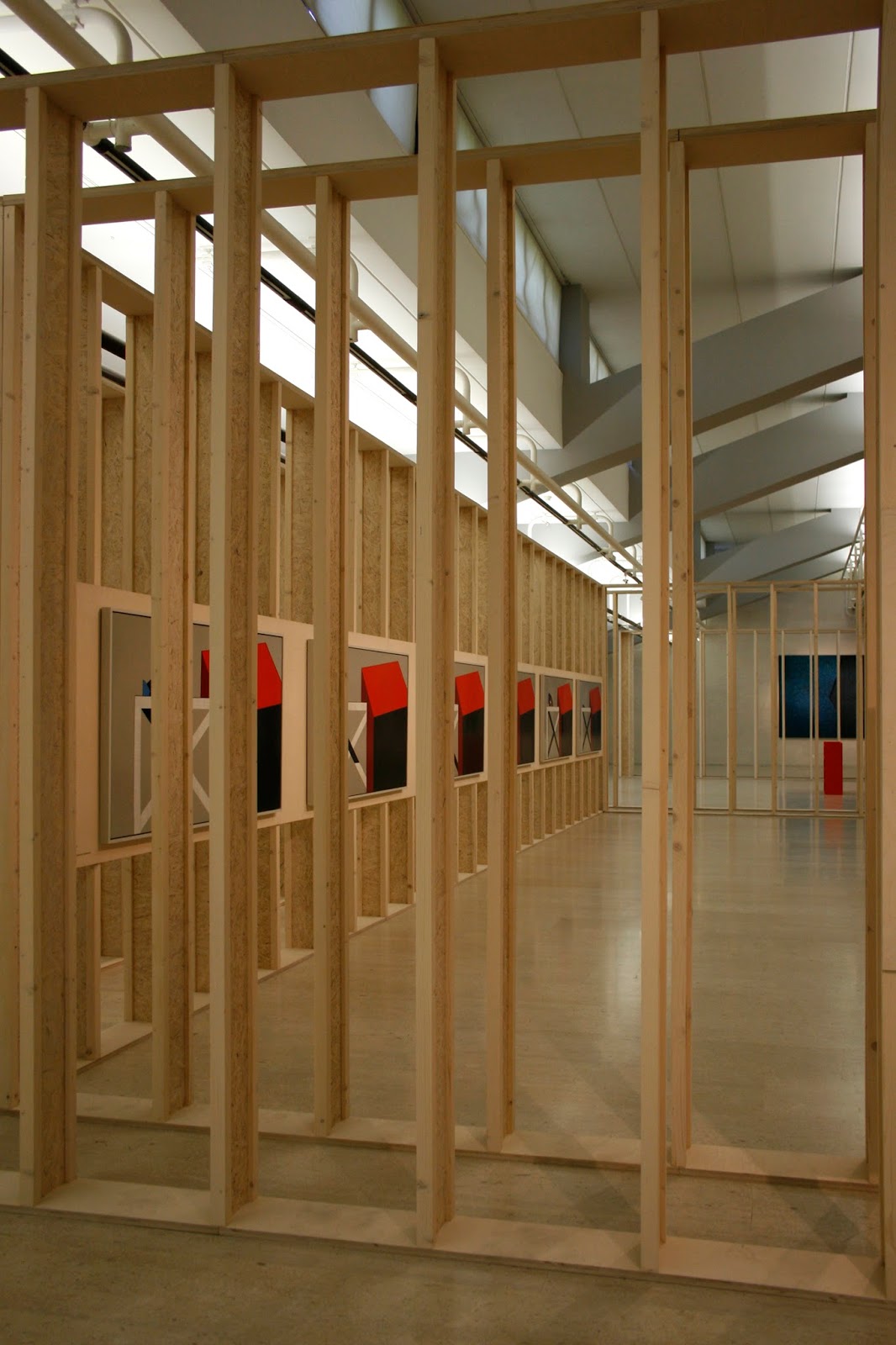
The courtyard of the Gallery
Until November 2nd 2014 there is a special section dedicated to Anselm Kiefer, the German artist. It is called:
"Anselm Kiefer: beyond landscape" and you can bet there is a whole world beyond his paintings. It is also a matter of dimension, being the paintings at the Albright-Knox so gigantic. That is not all, though.
Everybody talks about the monumentality of Kiefer's work, and of his personality. Even the insert in
The Buffalo News starts the review about the exhibition with the concept of monumentality. What I was actually surprised to feel, in front of the three gigantic paintings (each is hung in a dedicated room), was the smallness - of the spectator, that is totally defeated by the bigness of the pieces. And I think also of the smallness of the artist, while he is creating that. I try to imagine how could working on those paintings be, with your tools in your hands. I can figure the buckets, the brushes, very likely stairs or stools. Anything that could help to make the Art bigger, and the Man smaller.
If you want to understand the composition of Kiefer's places, you cannot get too close to it. It is as if the painting itself is keeping you a bit far. Far enough to think about the meaning beyond the landscape.
The three landscapes are very different: the Gallery guests the view of a <<post-apocalyptic field>> (Milky Way) but also a field of flowers (Der Morgenthau Plan) and a seascape from a private collection. The three of them are not connected, apart from the same level of power. <<To have more than one in the same room is like listening to many symphonies at the same time>> said the director Janne Sirén to Gusto's critic Colin Dabrowski. I totally agree: Kiefer is very explicit and powerful, in his art. There is no need or possibility to add anything more, most of all: another Kiefer!
These paintings are talking about history, Nature, human condition and philosophy. Kiefer said: <<True art does not portray beauty alone. Beauty requires a counterpart>>.
And in Kiefer's art, which I believe is true art, the counterpart is given by the mix of wonder and somehow sadness, produced by getting "in touch" with the subjects. There is something beautiful and deeply uncanny in each piece.
The field in Milky Way looks like painted in winter, which is also a winter of the senses, and of our thoughts. It reminds of a cemetery without graves, with no names. It's like the death of something that will never be reminded.
The seascape is framed with thick pieces of lead, and even if you don't know it's connected to the four rivers at the edges of Germany, the composition is really turbulent. There is only a moment of quiet, in the waves, represented by a flat spot in the paint. But that being just out the perfect center of the composition, it puts everything in movement again, with no rest for the eyes.
The flowers field in The Morgenthau Plan is a bit upsetting as well, in a way. You feel like a bunny in the field; you really feel overcame by the nature, remaining almost breathless in the flowers. But you could also put it as a try to hide in the nature, to be protected by that, even if in its fragility.
The monumentality (of Nature and History) and the smallness (of the humankind). These opposites fighting, creating a sense of vertigo, are the counterpart I can see in the beautiful Kiefer's art.
photo of the painting by Kiefer
Once out of the Albright-Knox Art Gallery, we just had to cross the street to reach the
Burchfield Penney Art Center. Such a concentration of art reminds me of capitals in Europe, like Paris. And I wish Buffalo to keep the good work up!
At the Art Center we visited the temporary exhibition Art in Craft Media 2013 (until January 19, 2014). It was a juried presentation of art made of wood, clay, fiber, glass and metal. The quality of each piece was stunning: all the artists were clearly masters of their art.
I loved the architecture of the space, so complex, maybe almost too defined in the shape of the areas, overall well proportioned. I remembered when the MAXXI, the Museum of Art in the XXI century, opened in Rome, couple years ago. It was designed by Zaha Hadid and many were the critiques against her job. It was considered to be not a museum, but a piece of art itself. People were saying it was impossible to display pieces of art, because of the exaggerate complexity of the space. They were saying: it's impossible to hung anything on the walls! But in the case of the space where the Art in Craft 2013 is hosted, there is a big difference: the areas are geometrically complex, defined by white walls, with high ceilings, but it is still flexible. The proof was given by the different sections arranged, one for each material.
I really enjoyed being able to focus on each section, as if it was an exhibition inside the exhibition, and look at the pieces.
Some were aesthetically gorgeous, transmitting a joy of life with no comparison. Others were deeply meaningful, expressing sadness or happiness. No piece was merely self-referring. No one. And ending the sequence with the great installation by Ben Perrone with the video of the interview to the author, is the proof that the exhibition is not only about aesthetics, but about ethics. His piece was the "War ongoing Project". These his words for the exhibit:
“I proposed to fill the Media room with thousands of small black bags hung from individual filaments at different heights from a foot above ground level toward the ceiling. In every bag would be the names of the war dead, from the present wars to past wars. The bags are metaphor for the life unlived” (see more on buffalorising.com)
Each bag contains a name of a dead soldier.
Every bag, is a life.
Ben Perrone video-interview
We started our morning with Kiefer, and his desire to go beyond the landscape, since beauty needs something more, and different. We ended our tour with another great proof that Art can, and has the duty, to go way beyond the media.
I recognize this is not always easy to achieve, but still is what we should always aim for, even as spectators. Because even if we are very small in front of the Art, we are there to judge.
And it is also because we watch art that... Art is Art. No Art without a public.
I would like to end this review with a request: do not accept art in a passive way. Try to be active, supporting the good and meaningful art, even just by reading about exhibitions in your town, and possibly by visiting them. Do not accept anything that goes: be incisive and always try to find a meaning in what you see. You don't have to be an expert, you just have to open your eyes and souls, and be very receptive. Do not let others be spectators on your behalf: go out, and try to learn from what you see (in museums, but in regular life as well). And if you feel there is nothing to learn from, or nothing to think about -and after- seeing a piece, then you'll know that's not a good piece of art.
Go beyond, always!