Friday, 5 October 2012

My Pechakucha Night! vol.13

Yesterday I had the wonderful opportunity to attend and present my work at the Pechakucha Night organized by the AIA in the Cultural Trust Educational Center.

Pechakucha Night is a nice event that allows people to present whatever they want but using only 20 slides, and having 20 seconds to explain each slides. It started in japan, but soon became a popular format and a lot of cities all over the world are organizing that. I saw the 12th edition in June, in PGH, and manage to submit my slides for the 13th. It was great fun for me and for the audience, I can assure.
I talked about the Italian designer Bruno Munari, a master of creativity, and of his book "Fantasia", edited by "Laterza", but only in Italian. 
If you are willing to discover more about him, you can start reading "Design as Art", another masterpiece by him, edited by Penguin.

I spoked about the big distinction between the faculties we use while creating: FANTASY, CREATIVITY, INVENTION AND IMAGINATION.
The book gives you hints on how to use them (and when!) in the correct way. this lead to saving time and have more fun, for sure.

I'm going to talk about Bruno Munari, an Italian designer born in Milan in 1907 and died there in 1998. I'll first present his philosophy and then the book Fantasia, about how to manage fantasy and creativity. In this image, for example, he is showing creative ways to use an uncomfortable armchair. 

Mr Munari designed products for big Italian companies such as Olivetti or Danese furniture. He was also an artist. In 1954 he won the compasso d'oro, the most important design award in Italy, for one of the first polyurethane foam toys, the monkey Zizi standing on his shoulder.  

He also wrote a number of books about the design process and art. He was able to face problems of production and communication. Here you see one of his most fun and famous books, speak italian, a kind of appendix to the italian vocabulary, explaining our way to wave like crazy, while talking.
 
He approached the world from a diffrent perspective, totally unconventional. He analyzed the smallest components of a concept, and then synthetized those to create something new, starting from everyday issues and challenges. Here you see the X-hour clock, for the momentous times of the day.

His first concern was very practical. He always worked between factory ownners and machineries. He was able to understand them and to use them in a unique way, making the difference even when it seemed technically impossible, for the mass production technologies repeting the same actions.

He was more focused on create values, than temporary trends. The way to do this, according to him, was mainly through fun. In this case you see one of his most famous pieces, the chair for short visits, to be offered to people you cannot stand. For the 45degrees inclination of the seat, you cannot really sit there for that long, so you are obliged to leave quickly.

Mr munari's process dealt with tools and concepts. He was the first that, when the Xerox copier were sold, found a way to contraddict the main feature, that is obtaining identical copies. By playing with the original, he could obtain other originals from a copy machine. 

His sane obsession for the machines and his passion for contraddiction brought him to play with concepts and language. From the fifties he started producing "unuseful machines", a contraddiction even in the title, because the machines are supposed to be useful for their own nature. He did that before Calder, but he used meinly light materials and paper.

Mr Munari was a very practical man. This bed, called "abitacolo" (that means "capsule") weights 100 pounds and has been tested with 20 kids playing. It saves space and stimulates kid's creativity, being customizable. This bed has been included in the Moma collection. It stimulates creativity in the kids, having movable shelves and pockets. 

 Mr Munari wanted to share his knowledge, in particular with kids. He's aim was first to teach the people how to see the world in a different way. then how to reproduce it and finally how to create new pieces. He wasn't that interested in extraordinary things, but in the beautiful ordinary, much more durable and less expensive. 

 Fantasia that means Fantasy. this book teaches how to deal with creativity, moving from simple rules that, once consolidated in your mind,  can lead to incredible results, when you mix them. This book is fundamental for everyone has a lot of creativity but need a way to quickly go strict to the point and producing powerful solutions.

 Let's start with meaningful definitions and distinctions: fantasy is everything that wasn't existing before, even if unfeasable. You can freely use fantasy with no limits. It is the most easy to use, but can lead to a big loss of time in you don't quickly shift to the other faculties.

Is everything that wasn't existing before, but it's a technical issue. You don't have to think about aestethics at this very step. It's all about technique and how to create something from materials, tools and machinery. You must know the tools and how they interact with the materials. Then it's all about process and.. money, of course.

Is everything that wasn't existing but it is feasable in a global way, also from a technical point of view. It use fantasy but with a final aim. Creativity is the one used in the design process, mainly.
This faculty is very important and everyone should "train" to keep it flexible and always ready to be used. The book gives you ideas about how to increase it.

While fantasy, invention and creativity require you to think, imagination is only asking to see. You can visualize whatever you want, without necessarily think about how to obtain that. When you have to find an idea, it is important to use the correct faculty, to save time.

In the book he talks about materials, colors, dimensions, multiplication of pieces, subtractions or sum of parts... he presents common features that is always possible to mix, twist and interpret in a number of ways. All the best ideas start from simple themes remixed to obtain something new.

 These are examples Of his creativity. A part from the female brush, my favourite, i also love the collection of "flowers in the salad" that became also a book. Playing with vegetables and fruit he created stamps for children. These are all ideas you can recycle in a rainy day with your kids.

Start simple and then go on. we are surrounded by extraordinary objects, some of theme even unuseful, and just very appealing. But You can find cool ideas starting from nothing. In this case he thought of a problem, just for fun, such as how to send a message in the bottle and then add a post scriptum, once you close it.


The book gives a lot of hints on how to stimulate creativity. Munari presents workshops he did for kids with creative games. Munari's workshop can be very useful also for adults. If you have no time to manage your fantasy, this book can definitely change your life.

I leave you with a bunch of contacts. I'm not earning a euro, from this, I just want to share with you a piece of the best Italy. 
There is this book fantasia, only in italian, but also design as art, in english. At the Estorick Collection, in london, there is now a solo exhibit on him. I really hope you had fun, and wish you to have a lot of good and winning ideas, as Mr Munari had!


(Special thanks to ©Kevin Kunak, for the picture!)


Sunday, 23 September 2012

White Cube, Green Maze: break the glaze!

On going exhibition at the Heinz Architectural Center (Carnegie Museum of Art, PGH) is something not to miss. You don't need to be an architect to get the sense of that. This is for two simple reasons. #1 finally an architectural exhibition clear and plane, with no over layered tables (unreadable even for experts in the field) nor under explained sketches by big Masters (typically "that big" that you just have to be happy to see "something" by them). You come, you se, you understand. #2 The projects and the theme are evident and well presented. Moreover, the projects themselves are very good, that's all.

The title "White Cube, Green Maze: New Art Landscapes"suggests a contraposition between the classical Museum (the cube) and the free explosion of Nature (green maze). The projects here presented are providing the "White Cube" service with a complex relation with the "Green Maze". Not an easy task when it comes to valorize the existing landscape and insert your new projects, with all the consequent yes and no by institution, guidelines and community. 
The exhibition puts together projects and their pictures by Iwan Baan «one of today's most influential architectural photographers». I was very pleased to see architectural photos WITH people living them. Each shoot is simply spontaneous and both architecture and visitors are presented in a pleasant way: people always busy doing activities, spaces exploited until the very last bench. The dream of every designer: it means 100% success. 

The main presented projects presented are:


ALL THESE PICTURES ARE © IWAN BAAN

A part from the Italian project, all the other are already built and fucntioning. The link activable by clicking on the name directly brings you to the official website. 

The projects here presented are all deeply connected with the surrounding landscape and announce a (hopefully) new era for the future architecture - not only of the museums. I am talking about an era where the buildings can respect the context, whatever it is, creating new places with no edges between "in" and "out". Great part of the presented projects are kept in order by the citizens (see the one in Japan) or are so open to Nature that even leaves and whatever can phisically enter them (the botanical garden and parks). 
Stiftung Insel Hombroich (Germany) ©Iwan Baan

These freed relation with the landscape allows the visitors to enjoy something more than the "frozen" masterpiece, celebrated on a pedestal. This is the celebration of a place, the making of a place. We cannot allow anymore "event buildings", made of ready effect to impress the masses. We are filling our lands, little by little, and giving meaning to them is more than urgent. This process shouldn't be only restoration (great part of these projects arose on abandoned areas or in need of care) but a true renewal.

A great example of this "making a place" is the Guggenheim Museum in Bilbao, by F. Gehry. Probably the first popular project that really did that, in a little city that desperately needed a reconfiguration (that happened on the riverfront).
2011 ©Beatrice Spolidoro

And what about architectural pictures? I think that Mr Baan gives us a great lesson of photography, with an amazing ability to create a story though each pic. Each project has its own story -as a building- but Architecture happens only when people are using them - that is another chapter of the story. Photography of architecture should present exactly these stories, valorizing place and people, celebrating civilization.

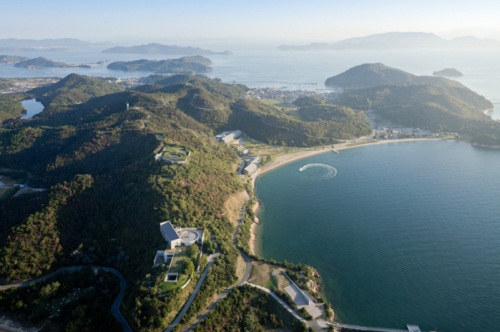
The Japanese project in Benesse Art Site Nahoshima is my favourite one, I must admit. But I would also recommend to give a look to the project by Tadao Ando on the Island of Awaji-Shima. Tadao Ando worked on the island that was partially destroyed to build the Osaka Airport (a man-made island). Even in this case, the park is maintained by the population of the island.

(all images of Awaji-Shima are 2009 ©Beatrice Spolidoro)

And this is the best conclusion for this post, waiting for the upcoming exhibit on Japan, again at the Carnegie Art Museum, titled "Japan is the key" (March 30th July 21st 2013).
Until then, keep fast and MAKE PLACES!

Sunday, 22 July 2012

Richmond Barthè at the AWC

(Image from an exhibit at the A. W. Center)

Last Downtown Art Gallery Crawl was interesting as usual. For the first time I wasn't there visiting on my own. Special guests were with me and I had to slightly modify my usual route, changing the stops. I missed some too "strange", but I discovered others, much more meaningful. 
Thus, I entered the August Wilson Center and I discovered that they were hosting some exhibits. I just wanted to show the lobby and the common spaces, but once inside, we could visit the Richmond Barthè exhibition at the first floor. 
Simply amazing. This was my epiphany of the 7/13/2012 art gallery crawl. Never I had seen something like this, I'm still thrilled now after a week! The author was born in 1901 (Bay St. Louis, MS) and died in 1989 (Pasadena, CA). << He graduated from The Art Institute of Chicago in 1928, and then spent several months in New York, established a studio in Harlem, and eventually moved to NYC permanently in 1930. During the next two decades, he built his reputation as a sculptor. He is associated with the Harlem Renaissance. He won a Guggenheim fellowship twice and other awards. By 1934, his reputation was so well established that he was awarded his first solo show at the Caz Delbo Galleries in New York City. Barthé experienced success after success and was considered by writers and critics as one of the leading “moderns” of his time. Harlem was one of the three major centers of gay life in New York in 1930, and Barthé soon became integrated into Harlem's gay world. Throughout his career, many of his patrons and subjects were other gay men, and the exploration of both race and eroticism were central to his work.>> (Wikipedia)


The presentation was pretty small (and free! this is a good indicator of how much effort is put in art, in order to involve people. Also this is PGH) but there was plenty of sculptures, pictures and videos.
Again, I've never seen something like this. Suddenly, while looking at those statues, I remembered all the art lectures I attended at the University, all those about classical sculptures. Just like those in the Hellenistic period, for example. The iconography is different from the classical one, but the mind naturally recollects the images of Scopas, Lysippos and Praxiteles. Still there is something different, sincerely new and not classical. 

The position of the sculpted characters is not Western nor Oriental. It's a different way to portrait the body, with weird lines of strength (weird only if you try to apply the classic (and Wester - or European) canons. The body doesn't follow the gravity and there is no interest in a vertical movement. Though, the human body is strongly linked to the Earth, but develops according to horizontal planes. The line is not enough to comprise the energy flowing from the statues. If you try to design a line along the bodies, you'll end with circles or bizarre tangles. 
You need a surface (plane or curved) to catch this flow of culture, tradition and humanity summarized in each statue. 


Even the portraits of heads (also those representing Christ or Madonnas) are evidently not Western, nor European. I'd probably have to say they are Afro-American, maybe. But this kind of iconography is pretty amazing and new. I've never seen other examples such powerful and clear in the way they express life. And what a life...


Confrontation between Barthè and a Greek-Roman statue


Lysippo, on the left, and Barthè on the right.
 Graduating in Chicago, from the Art Institute, he likely studied the bases of the sculpture from its origins, getting in "touch" with the Masters from Europe and the classic tradition. Then, the way he used the lessons learned, applying those to his personal experiences and approach to the world and to the society, is really worth seeing - in person.
Until September 15, 2012


The Gallery crawl, anyway, wasn't only that wonderful exhibition... There was plenty of interesting stuff (please note: I'm saying stuff - interesting but "stuff", compared to R. Barthè's work).


Here some pics from the Wood Street Galleries. Playing with light, shadows, a spoon and some plastic bottles. A simple engine moves light and spoon in order to change the direction and proximity of the light source.


 Playing with light, again moving... turbine of lights, revolving at high speed for different effects (on the visitor!!)

 Jerry Irwin at Space Gallery.

And then all the other spaces along Penn Avenue...
I mean, I don't have to make a detailed map of all the galleries. The event is the street itself, something you can easily do with no special guide or gps. It's chaotic but self explaining. If you get lost, keep following the people.
For one afternoon a month, the city becomes a puzzle made of layers, or a book with pages in trace paper; each layer is much or less detailed and dense of things. All the page dialogue each other, mixing the information.
You just have to turn over the pages and create your own story.