Sunday, 6 April 2014

Pecha Kucha #17 - Carnevale a Schignano

On Thursday April 3rd, Pecha Kucha Night was held again in Pittsburgh, for the 17th time. The hosts were AIA Pittsburgh and AIGA Pittsburgh. The location - very appropriate - was the Melwood Screening Room at the Pittsburgh Filmmakers.

I was the third to present, and this time (my fourth time!) I spoke about the Carnevale in Schignano. It was a mix of Italian Tradition, Culture, funny stories about a village, and lots of cousins.

Before publishing my slides, I just want to say that what you'll see in the slides is just a 30% of all the things will happen at the Carnevale. Nevertheless, it is a good introduction to a fascinating event, which is gaining more attention at a national level, in Italy.

Here my Pecha Kucha. Enjoy!

1) First the place: Schignano is my grandma’s village in the North of Italy, Lombardia, near Lake Como. I was born in Milan but spent half of each year there. It’s an old place, poor but fascinating. We have wonderful mountains, forests, fields…

 2) …we have George Clooney, weather permitting. Schignano is very close to Laglio, where he has a house, and we are very proud of him. We would put him out on a balcony, with the flowers, to attract tourists. But now the Carnevale. Our is not very famous, but old. It was founded in the 14th century!


3) It happens every year around February, before the Catholic Lent. The dates would slightly change every year. In Schignano it is like a parade of traditional characters. The public would watch from the sides of the streets, as the parade moves. It’s like a theater, without a fixed text. We mainly have two categories of characters:


4) il Bello, the goodlooking, represents the rich people of the village. Rich families used to play this role, since the costumes were expensive. They have wonderful masks carved in walnut wood, in a light color. Some masks are 100 years old, but people still carve them nowadays. They are really heavy, but wonderful.


5) the Bello has a colorful hat, with silk laces and ribbons, and full of mock flowers. They have many details sewed to their costumes, like glazed or plastic jewels, little dolls and they carry decorated umbrellas, to show their wealth. That’s what they do.


6) On the other side, the Brutto is the ugly one, representing poor people, and in particular the manual laborers coming home from abroad, during the winter. That was very typical of poor people: leaving the village for almost a year. Poor families played the Brutto. They usually have empty and broken luggage, to represent the fact that they had to leave the village for work. 


7) The Brutto wears shreds and smelly furs of dead animals, and ugly wooden masks. The mask is really scary, and it is sometimes colored with red on the lips. Which is even more scarier. With a nasty smile. This one is my 6 years old cousin, Federico. My family is a family of Brutt!


8) There is only one special character. It’s the ciocia, the poor wife of a rich Bello. It’s always performed by a man. She would shout out loud, in dialect, complaining about her miserable condition, dragged around by her husband  with a rope. Since ever, the best ciocia is this guy, called “the magic”. He is my uncle Domenico. 

9) The Carnevale in Schignano is full of noises: people would shout to encourage the characters. Then there is the music from the band and most important, the bells of the masks. The Bello has the rich “bronze”, out of bronze. These are very expensive, and when Carnevale was over, they were used for the real animals at pasture.


10) On the contrary, the poor Brutto has poor bells, out of iron or aluminum. They have a dumb sound, compared to the crystal clear one of the bronze. Again, the bells would be taken on and off from the animals at pasture. They are wore with thick ropes around the waist. 


11) Carnevale in Schignano is very active. This is another cousin of mine, running after a Bello with a broken chair. This is part of the unwritten ply that happens every year: the tricks of the Brutt to the Belli. People would anyway prefer to be a Brutt, even if they become rich, because it’s funnier to be a Brutt. 


12) Brutt have no respect for anyone. They would stop cars, laying on them, or grab the people and touch them in the face, usually with the smelly skins of the dead animals or getting you dirty with only God knows what, and wine. Your first time at the Carnevale could be really upsetting, if you are not ready. 


13) This is the antique dealer of the village, and he has always the most amazing objects. Poor people would show up with broken old tools, usually working tools like sweeps, rakes, shovel. Here you see the gerla, which is a backpack made of crossed sticks. 


14) The Bello would go around the parade walking slowly, and showing off his costume. They are gently and elegant. My Grandma is one of the official tailors of these costumes. The waistcoat is full of dry leaves, collected new every year. She would fix the costumes, and sew the pants.


15) The fabrics are very colorful, some are very old. After getting dressed, you would add all the details, like the jewelry and the wonderful needlework. Many have very old umbrellas, symbol of wealth, or precious fans.The stick as well is pretty important and equally decorated. It is used to keep the Brutt away.


16) The Brutto would go around in a slovenly way, running like a mad, covered with rags and furs. Running is their main activity, to make the ciocche sound louder. Plus they would jump on you, trying to show off as well their stuff, even if it is poor and disgusting.
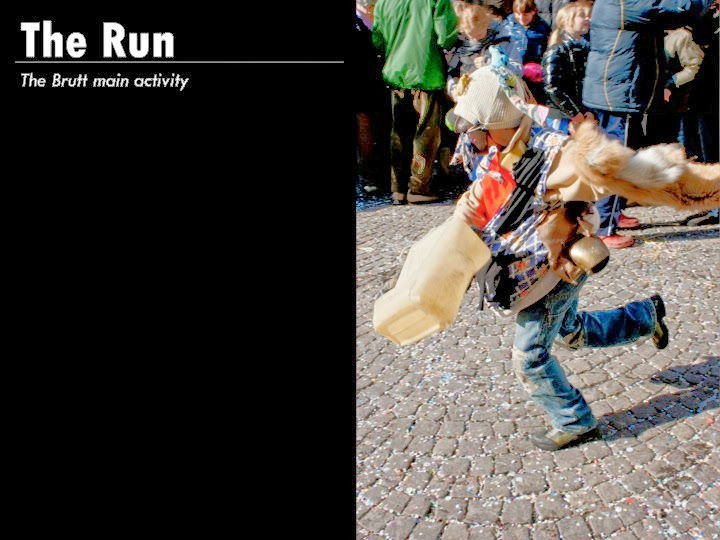

17) Since all the running is very tiring, they would suddenly and randomly stop, to rest. Anywhere! On the walls, in the middle of the street… they really look dead, or injured. They are usually just drunk, since people would drink for days, to best perform.


18) But the rest is really the Brutt second activity, apart from fooling around. People who see the Carnevale for the first time would think they fainted, or that they are not feeling well. As they get closer, the Brutto would jump as a cricket, push them, and run away.


19) But the best of the Carnevale in Schignano is that under many mask you see plenty of young kids, boys and girls, and they are the strength of the event. Fathers and Grandfather are very proud. Who is not dressed, knows the mask by heart, and the kids are always safe.


20) But I want to end my presentation with Chiara, half Italy and half Capoverde, who is a friend of mine. She is the best part of the Carnevale in Schignano, showing that the best traditions must renew and include everyone. 

the official website http://carnevaledischignano.it/
(Italian)

All my photos about the Carnevale

A project that you can help:
An entire book about the Carnevale in Schignano!
(English) 


Thursday, 23 January 2014

Sustainable luxury


The Green Building Alliance in PGH has organized a tour of the Fairmont Hotel in Downtown Pittsburgh, with the Emerging Professionals that wanted to learn more both on sustainability and luxurious spaces. Despite the two things could seem a bit in contrast, the Fairmont (as a chain of luxury hotels) has showed us that it is indeed possible to go green, from the first day of construction and on a daily basis, and be really classy.

Our tour started in the lobby of the hotel, located at 510 Market Street, Downtown PGH. We were brought around by a very special guide, Julie Abramovic, Public Relations Manager at the Fairmont Pittsburgh.  She explained us how the whole building was carefully built, trying to save on materials and reducing the distance between production of the pieces and their final location. She said that even the furniture was selected to be as much "local" as possible. A regular luxury hotel, would order pieces from other continents (Europe in primis, for the American hotels). The Fairmont Pittsburgh is a LEED GOLD project (since the opening in 2010) thanks to the way it was built and how it is run, every day. Julie ensured that the approach to sustainability is usually pushed from the Staff, even in the maintenance area. From the offices to the kitchen, everybody is well aware of this mission. A team of engineers would also improve the daily routine, with specific projects to improve the life of the hotel.

Plants in the lobby, in collaboration with the Phipps Conservatory.

A part of the tour that I really enjoyed was the one presenting the archeological findings, collected during the construction. Archaeologists were hired to make a catalog of pieces, dated around the 19th century. Many bottles and kitchenware, together with objects from historical businesses existing in the area, are now displayed in the common areas of the Hotel. You can see them on the first and second floor, and on each floor, as well.


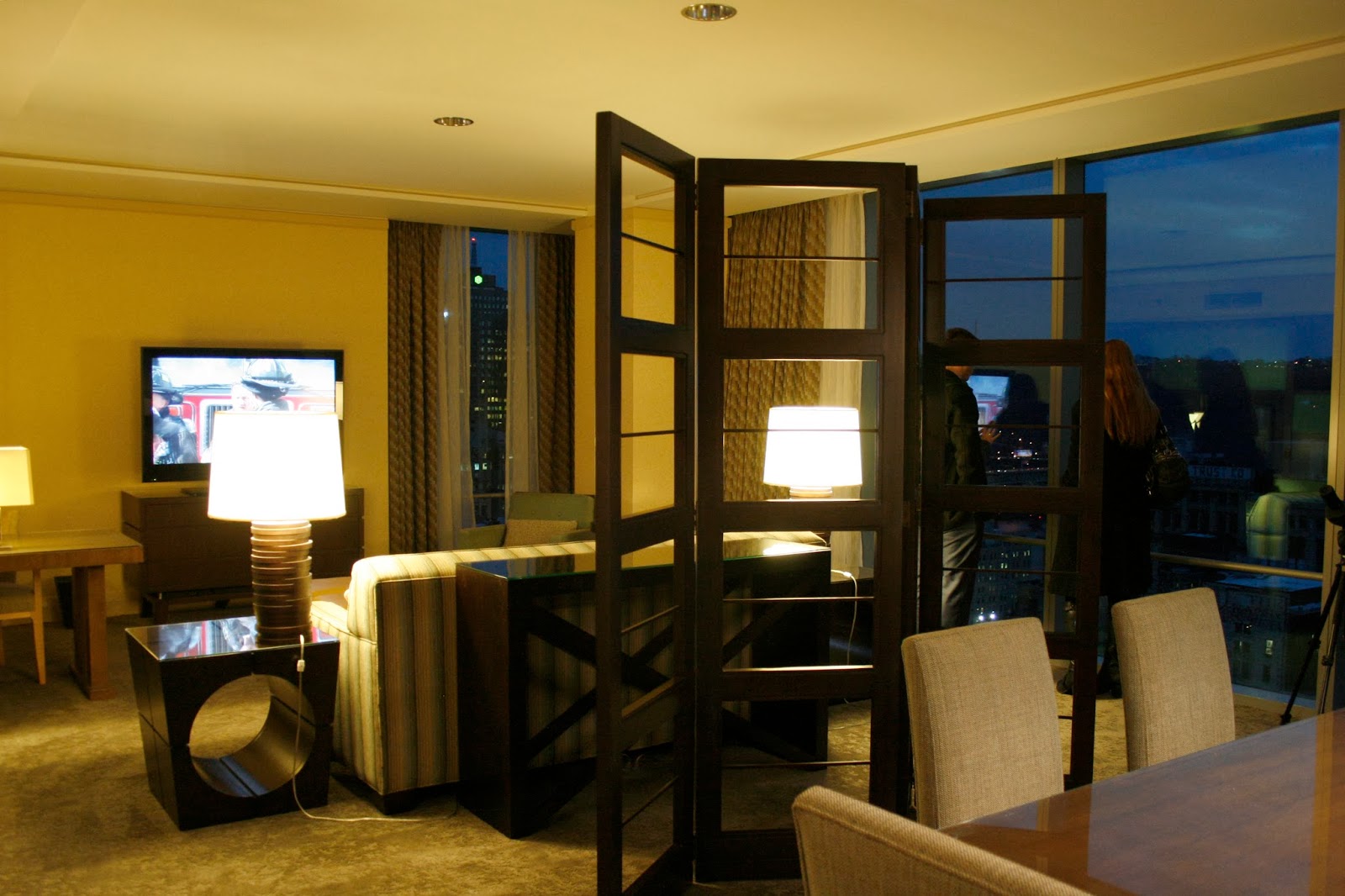
Our tour was including also a visit in one of the suites; sustainable and rich at the same time:

The complimentary water: each floor has the ice vendor and a water dispenser. You can have it from there, and not bottled in a factory. 


Not sure it is sustainable, but God bless whoever invented the TV hidden in the mirror of the master bathroom. Very chic.

And then the views, from such an hotel, cannot be forgotten: another good reason for attending the tour, and maybe get a room there, for a special occasion.


Sunday, 5 January 2014

The First Art of.. the year 2014

Despite the temperatures outside weren't those to stimulate any mental faculty, I took the bus and reached the area of the Galleries along Penn Avenue. All in all, it was January the 3rd, the first Friday of the month and of the 2014: I felt like celebrating the beginning of both with a pinch of art.
Here an anthology of the interesting things I saw, in order of apparition:

  • Modernformation Gallery

“Our Interconnected World: art and science at the Environmental Charter School”

Presentation of works by kids attending the “Thinking Lab” at the ECS. Students are supported as they tap their creative energies through an exploration of concepts where art and science meet. Students explored Frick Park and then reproduced their memories and sensations through watercolors. Despite the simplicity of the pieces, the overall presentation was very nice and upstanding. All the pieces were on sale, for a reasonable price. I would say that this is a nice lesson of genuine democracy of art. And for one time, I mean it in a positive way. 

I loved the many comments from the students, while and after doing their masterpieces. 
Being a very weak "watercolorer", I totally agree with the statement underneath:


  •  Stuff N Such Society

(Basement of Most Wanted Fine Art)
"Darth ad Dolls"
The pieces below captured my attention because... sincerely: they are funny. My favorite piece is the Young Luke Skywalker, painted on Darth Vader. It's almost philosophy there. Almost...

Below, Jia Ji, the artist. 

  • The Irma Freeman Center for Imagination

"Make Moves" by Billy Shannon
It is rare, nowadays, to find something interesting in ready-made art. But Bill Shannon did some interesting indeed, and I loved the section of the gallery in which he is displaying some of his found pieces, after being offered a second chance. I found them elegant and very expressive. And a talk with the artist allowed me to discover some stories behind some of them. 
The writing DREAM is composed with salvaged and selected letters, from a building in demolition. And the "love chair" below, was and industrial piece transformed in a comfortable seating. Much more appealing, but still reminding of how tough life (and love) can be. But apparently, it's up to us to make the things more comfortable. Some pillows will help.


Below: a gigantic panel with a scene in the middle. It's a sort of castle made of pieces found in many different occasion, and put together by recollecting memories and images.

Below: pieces found in industrial sites and along railroads. All the pieces can be found and stored for a long time, and being used only when there is a clear vision for them. Billy said that he could go back to work on certain pieces even after months. Art is never finished, in a way, and each piece is the demonstration of a life that keeps evolving, even in objects.
I love the lamp, hanging from the ceiling, but probably from much further away.


  • SPACE GALLERY see more here
"Behind our scenes"
up to 01.26.14
This exhibition is all about photography, but there are some works that become almost spatial, if you consider the content and the staging of the pieces. I loved the photos by Annie O'Neil and Nacy Andrews, about an abandoned red-light theater. Some prints were very nice and the overall use of colors very pleasant and well developed. 

"Eleanor's Animal Farm" by Dennis Marsico was very interesting as well, with spatial short-circuits between the world of a 14 months old kid, and the world of adults. She is playing in her world, full of plastic animals. And a true cat, sharing its food with the toys. Other works by Dennis were also displayed, even if this was the one that most stimulated my fantasy.

Barbara Weissberger (in the image below) was displaying some photos about magic and organic collages, full of colors and hidden meanings. The overall composition was very different from piece to piece, in a pleasant complexity in front of which you can spend a fair amount of good time. 

(image above taken from the SPACE Facebook Page. ©SPACE Gallery)


  • Future Tenant
up to 01.12.14

Cool experiment of a group of artists, selected by Joseph Lupo. Each artist had to interpret a page from a comic magazine on Iron Man. Some interpretation were hilarious, other very psychological, and many were just great to see. Something to check out in person, before the exhibit closes on january 12th. If you are Downtown, stop by - you won't be disappointed.
(above: official poster from Future Tenant website. ©Future Tenant)

Wednesday, 4 December 2013

Think bigger and live smaller: the Tiny Houses Experiment in Garfield

Think of your neighborhood. Think about what is good and bad. Look at the market rates and start figuring out smart ways to invest. Then be awarded with a grant from the Pittsburgh Partnership for Neighborhood Development. Wait a minute, are you living in Garfield? 
I was thrilled to learn about this great idea that CityLab came up with. 
From their website:
<<cityLAB believes that building small houses could make a big impact, and we will begin studying how to bring Tiny Houses to Garfield in late 2013. The idea of Tiny Houses was one outcome of our 2011 6% Place book, which examined how Garfield and Garfield residents could benefit from a systematic effort to grow the neighborhood’s creative capital and attract new residents. cityLAB has recently been awarded a grant by the Pittsburgh Partnership for Neighborhood Development to bring this idea to fruition.>>Thus, a brainstorming session, open to the public, was organized for December 3rd 2013, at the Assemble Gallery. CityLab organized the event as a workshop in which resident in Garfield and anyone interested in tiny houses could express ideas, concerns and desires about the subject.

(above: one of the slides presented at the brainstorming session, on Dec. 3rd 2013)


The workshop, attended by many people (almost too many, for the space, but the theme was really appealing) was divide in three intuitive exercises. In the first, we had to fill a questionnaire, and possibly add comments, regarding the matter of "living small". We where assuming a space which is around or less 1000 SF, but there are no established rules, and very little precedents. We were asked questions regarding which density we would like around us, which public services we would prefer, near our place. But also: need of parking, or shared services, or needs for a vibrant community of other tiny houses vs a in-fill strategy, with our tiny house compressed between existing buildings, way bigger.


The second exercise was more involving. We were given 12 stickers in shape of stars, and a sheet with different possibilities to spend our stars. Many ideas had different "prices", according to the space, the facilities, the things we wanted to put in a house. This was to understand the must of a tiny house, according to us. What you can and cannot renounce to.


The third was definitely hands-on, and it was interesting to see how, despite the big number of participants and the little available space, people really produced great results. We were given scissors, glue, and sheets full of photos. We had to invent a sort of article for a magazine, imagining that our tiny house should have been the cover story of that. We had to come up with a title, tag line and lede (great word find out by Dutch MacDonald, from MAYA design, who was leading the experiment and workshop). Then, we had to select our photos according to the things or features we would like to see in our tiny house. This was a great way to collect data, involving people in finding and expressing their ideas.


Dutch, leading the workshop, from the top of a ladder!

The workshop was absolutely flexible and open to changes. It was really an experiment, brilliantly conducted by Dutch and the CityLab crew. People expressed their availability in DYI, or their concern about money, environmental issues. No one was an expert, but interesting points were brought to the table: economics, society, and physical environment were themes deeply discussed.I was so glad I attended it. And now I can't wait what's next. Everybody will be very excited about learning more, most of all the organizers of the event - that really want to test the field and see "what's the weather like" over Tiny Houses in Garfield.To me, more than learning more about the Tiny Houses Movement, the event was also a great lesson on how to involve people, and how to collect meaningful data. It was really entertaining, but full of information. I am sure we'll hear again about this project. I will follow them again, and will keep you posted.


Check their website, to learn more about others Garfield-based projects and experiments!

And here to learn more about the Tiny Houses Movement.


Sunday, 1 December 2013

Buffalo: beyond Art

     I came to Buffalo for Thanksgiving, joining my American family, and we visited the Albright-Knox Art Gallery

The courtyard of the Gallery

Until November 2nd 2014 there is a special section dedicated to Anselm Kiefer, the German artist. It is called: "Anselm Kiefer: beyond landscape" and you can bet there is a whole world beyond his paintings. It is also a matter of dimension, being the paintings at the Albright-Knox so gigantic. That is not all, though.
     Everybody talks about the monumentality of Kiefer's work, and of his personality. Even the insert in The Buffalo News starts the review about the exhibition with the concept of monumentality. What I was actually surprised to feel, in front of the three gigantic paintings (each is hung in a dedicated room), was the smallness - of the spectator, that is totally defeated by the bigness of the pieces. And I think also of the smallness of the artist, while he is creating that. I try to imagine how could working on those paintings be, with your tools in your hands. I can figure the buckets, the brushes, very likely stairs or stools. Anything that could help to make the Art bigger, and the Man smaller.
     If you want to understand the composition of Kiefer's places, you cannot get too close to it. It is as if the painting itself is keeping you a bit far. Far enough to think about the meaning beyond the landscape. 
The three landscapes are very different: the Gallery guests the view of a <<post-apocalyptic field>> (Milky Way) but also a field of flowers (Der Morgenthau Plan) and a seascape from a private collection. The three of them are not connected, apart from the same level of power. <<To have more than one in the same room is like listening to many symphonies at the same time>> said the director Janne Sirén to Gusto's critic Colin Dabrowski. I totally agree: Kiefer is very explicit and powerful, in his art. There is no need or possibility to add anything more, most of all: another Kiefer!
These paintings are talking about history, Nature, human condition and philosophy. Kiefer said: <<True art does not portray beauty alone. Beauty requires a counterpart>>. 
And in Kiefer's art, which I believe is true art, the counterpart is given by the mix of wonder and somehow sadness, produced by getting "in touch" with the subjects. There is something beautiful and deeply uncanny in each piece. 
The field in Milky Way looks like painted in winter, which is also a winter of the senses, and of our thoughts. It reminds of a cemetery without graves, with no names. It's like the death of something that will never be reminded.
The seascape is framed with thick pieces of lead, and even if you don't know it's connected to the four rivers at the edges of Germany, the composition is really turbulent. There is only a moment of quiet, in the waves, represented by a flat spot in the paint. But that being just out the perfect center of the composition, it puts everything in movement again, with no rest for the eyes. 
The flowers field in The Morgenthau Plan is a bit upsetting as well, in a way. You feel like a bunny in the field; you really feel overcame by the nature, remaining almost breathless in the flowers. But you could also put it as a try to hide in the nature, to be protected by that, even if in its fragility.
The monumentality (of Nature and History) and the smallness (of the humankind). These opposites fighting, creating a sense of vertigo, are the counterpart I can see in the beautiful Kiefer's art.

photo of the painting by Kiefer

Once out of the Albright-Knox Art Gallery, we just had to cross the street to reach the Burchfield Penney Art Center. Such a concentration of art reminds me of capitals in Europe, like Paris. And I wish Buffalo to keep the good work up!
At the Art Center we visited the temporary exhibition Art in Craft Media 2013 (until January 19, 2014). It was a juried presentation of art made of wood, clay, fiber, glass and metal. The quality of each piece was stunning: all the artists were clearly masters of their art.

I loved the architecture of the space, so complex, maybe almost too defined in the shape of the areas, overall well proportioned. I remembered when the MAXXI, the Museum of Art in the XXI century, opened in Rome, couple years ago. It was designed by Zaha Hadid and many were the critiques against her job. It was considered to be not a museum, but a piece of art itself. People were saying it was impossible to display pieces of art, because of the exaggerate complexity of the space. They were saying: it's impossible to hung anything on the walls! But in the case of the space where the Art in Craft 2013 is hosted, there is a big difference: the areas are geometrically complex, defined by white walls, with high ceilings, but it is still flexible. The proof was given by the different sections arranged, one for each material. 


I really enjoyed being able to focus on each section, as if it was an exhibition inside the exhibition, and look at the pieces. 
Some were aesthetically gorgeous, transmitting a joy of life with no comparison. Others were deeply meaningful, expressing sadness or happiness. No piece was merely self-referring. No one. And ending the sequence with the great installation by Ben Perrone with the video of the interview to the author, is the proof that the exhibition is not only about aesthetics, but about ethics. His piece was the "War ongoing Project". These his words for the exhibit: “I proposed to fill the Media room with thousands of small black bags hung from individual filaments at different heights from a foot above ground level toward the ceiling. In every bag would be the names of the war dead, from the present wars to past wars. The bags are metaphor for the life unlived” (see more on buffalorising.com)


  Each bag contains a name of a dead soldier.
Every bag, is a life.

Ben Perrone video-interview

We started our morning with Kiefer, and his desire to go beyond the landscape, since beauty needs something more, and different. We ended our tour with another great proof that Art can, and has the duty, to go way beyond the media.
I recognize this is not always easy to achieve, but still is what we should always aim for, even as spectators. Because even if we are very small in front of the Art, we are there to judge.
And it is also because we watch art that... Art is Art. No Art without a public.
I would like to end this review with a request: do not accept art in a passive way. Try to be active, supporting the good and meaningful art, even just by reading about exhibitions in your town, and possibly by visiting them. Do not accept anything that goes: be incisive and always try to find a meaning in what you see. You don't have to be an expert, you just have to open your eyes and souls, and be very receptive. Do not let others be spectators on your behalf: go out, and try to learn from what you see (in museums, but in regular life as well). And if you feel there is nothing to learn from, or nothing to think about -and after- seeing a piece, then you'll know that's not a good piece of art.

Go beyond, always!