Friday, 21 August 2015

The Story of Collapse


I was published again, on the AIA Pittsburgh eColumns (the online magazine of the American Institute of Architects, Pittsburgh Chapter).
Click here to read my article on Seth Clark, a very talented artist based in Pittsburgh.

" Beyond the subject-matter of the work, Clark’s compositions are well balanced and almost pleasant. They don’t provide solutions. They capture a condition that, as architects or even residents of less popular areas in the city, we are seeing repeatedly: abandoned buildings and deterioration. His technique is powerful and mastered: the collages are hyper-realistic, but also composed in a surreal manner. "


Friday, 24 July 2015

The Jason Pettigrew Memorial ARE Scholarship

I am very pleased to announce I am one of the 2015 Recipients of the Jason Pettigrew Memorial ARE Scholarship. It is a scholarship organized by the AIA at a national level.

Applicants should demonstrate one or more of the following attributes:

• Significant contributions at an early stage of career to the profession and/or community;

• Exemplary involvement in community and/or professional organizations;

• Outstanding achievement in the creation, development and delivery of creative programs for students, interns, Associates, and/or young architect members;

• Demonstrated passion for pursuit of registration.

Click here to see all the 10 recipients. Below is my bio:

Beatrice Spolidoro, Assoc. AIA, is a 2011 graduate from the University Politecnico of Milano in Italy, with a Master’s Degree in Architecture. She regularly volunteers at the AIA Pittsburgh chapter and for the Young Architect Forum (YAF) of Pittsburgh. Spolidoro is the recipient of the Young Architect Studio Competition, 2012 edition. She has been working as an Intern for the Pittsburgh based architectural firm Rothschild Doyno Collaborative since 2012. She has been involved in projects that aim to rebuild communities and align the goals of many Pittsburgh neighborhoods. In addition to helping the design development, she has been focusing in the storytelling of such projects and in facilitating the delivery of complex concepts.


A huge thank you goes to my firm, Rothschild Doyno Collaborative, and all the wonderful people working there. Geoff Campbell has been my tutor and mentor since 2012 and I really value his help and guidance. 

Another huge thanks goes to Mindy Fullilove, MD for the opportunity to contribute to her book Urban Alchemy. She taught me what welcoming means, and many precious lessons of "architecture for the people". 

I really admire the AIA Pittsburgh Chapter and its staff, particularly Rachael Kelley. The Young Architects Forum benefits a lot from all the efforts Rachael put in coordinate us. Thanks for the support you constantly provide!

Finally, thanks to Pittsburgh, for being such an amazing place to grow as an architect. It is a wonderful mix of challenges and opportunities. Plus fun. 

Monday, 12 January 2015

Milan Times

A short video from Milano 
(c) Bea Spolidoro - September 2013 

It is official: my city, Milan, has been selected to be the 1st place you have to visit in 2015. According to the New York Times, 52 "once-avoided destinations become must-sees and familiar cities offers new reasons to visit". In a world ruled for years by systems too big to fail, it is now the golden age of the underdogs (after the big systems failed indeed). I smile thinking that my city is the first of the once-avoided destinations. Truth, after the excitement of discovering I am Italian, people are a bit perplexed still now, when I tell them I am from "Milano". Then I underscore that I am from the very center of Milan, like 10 minutes walking from the Duomo, pretending I didn't notice their bafflement.
Sunday morning I opened the NYT and I could recognize, even without wearing my glasses, the familiar shape of the guglie, the gorgeous gothic pinnacles of the Duomo. For me, it was indeed what we Italian describe as a "dive of the hearth", a mixed sense of nostalgia and happiness, that makes you feel as if your hearth is diving into a pool. 

(c) Bea Spolidoro

I started reading the article, which was a serie of recommendations for tourists spending 36 hours in Milan. Quite a big leap from the typical 36 minutes spent at the Milanese airport only, waiting for the following flight. This year is special, though, for the next EXPO will be hosted here. The theme is food and "feeding the planet". As a comedian noticed some years ago, this is typical of people from Milan: we always think bigger...

Back to the NYT: "Twenty million visitors are expected to visit the city for the Expo, a mammoth event that runs from May through October and involves more than 130 participating nations and organizations sponsoring more than 60 pavilions. The Expo’s theme focuses on food, nutrition and sustainability practices — a fitting choice for a city steeped in Italian culinary traditions."

The related article starts with a video in Italian with subtitles, in which some people are describing the city. In the opening, a man sincerely states that Milan is not a touristic city: it is an Italian city,  "founded for work, industry". That is pretty much what I always say as well, and it usually sounds like a threat. After years of saying that, I am convinced it is just a way to protect our city from the tourists, so that we can keep working smoothly. Nevertheless, Milan is indeed a wonderful city. It deserves to be visited. 
Milan it is not only shopping, food, design, industry, fashion... Milan is a very attractive city, from an architectonic point of view. There is only one thing that some people might regret: the presence of nature is very sporadic, but when you can find a green spot, it is indeed a wonderful garden, able to compete with the Japanese ones. The rest of the city is an architectonic manifestation of how 50 shades of gray could look - and I am thinking of concrete tonalities! 

As an architect, and a big supporter of my city, I don't want people to visit Milan only for what the NYT selects. Out of 11 items, 6 are about food and drinks, 2 about shopping, and only 3 items are about museums or churches, carefully surrounded by places that sells food and drinks.
I will split the article in two part: first the history, then my recommendations.
This will be a semi-serious version of Milan, with some carefully selected historic facts and some partisan explanations of why Milan is how it looks like today. Or as we say in Milan, why Milan is a big Milan. This is not a scientific article, but if you happen to be in Milan for 36 hours, you'd better follow my recommendations. 


BRIEF HISTORY OF MILAN

Milan was founded by Celts, which were not exactly friendly barbarians, and left in us a sort of atavic grumpiness that you'll have to face, soon or later in Milan.
There are different explanations for the name of the city. One version says someone recognized that the only noticeable feature of the place was to be "in-the-middle-of-the-land" (written Medio-lanum). Another version, this legendary, says that, after a war, people found a boar with "medium-length hair" (also written Medio-lanum) on the site. That was the sign to found a sanctuary, around which Milan arose. 

(c) www.storiadimilano.it

Milan has always suffered from having a poor weather in a very sunny country. The natural activity in such a place was, since the beginning, working a lot - possibly indoor. 
While Ancient Romans were conquering even sunnier places around the Mediterranean, Milan was already working in a frantic way, likely creating what can be considered a primitive form of pollution.
During the Middle Ages, Federico Barbarossa conquered Milan, arriving from places that had a weather even worse than Milan. All in all, he couldn't complain and remained and adapted to the Milanese work-life balance. 

image from www.ilgiorno.it 

In 1386, the Cathedral of the city was started. The famous Duomo di Milano, despite the prodigious Milanese efficiency, was said to be never finished, due to continuous changes. Some would say it was just because the Milanese fashion was changing so quickly, that the building couldn't keep up with the following fashion season.

In the Renaissance, Milan was flourishing thanks to commerce, and the Duke of the city Ludovico Maria Sforza invited some great Tuscan artists, like Leonardo da Vinci. Milan was the only city that asked Leonardo to do something practical, like war machines or hydraulic masterpieces and very complex dams. The few drawings Leonardo made in Milan where likely sold to make profitable investments. The rest was stolen by the French army, which made way better use of the masterpieces. We still have the Last Supper, firmly attached to a big wall.


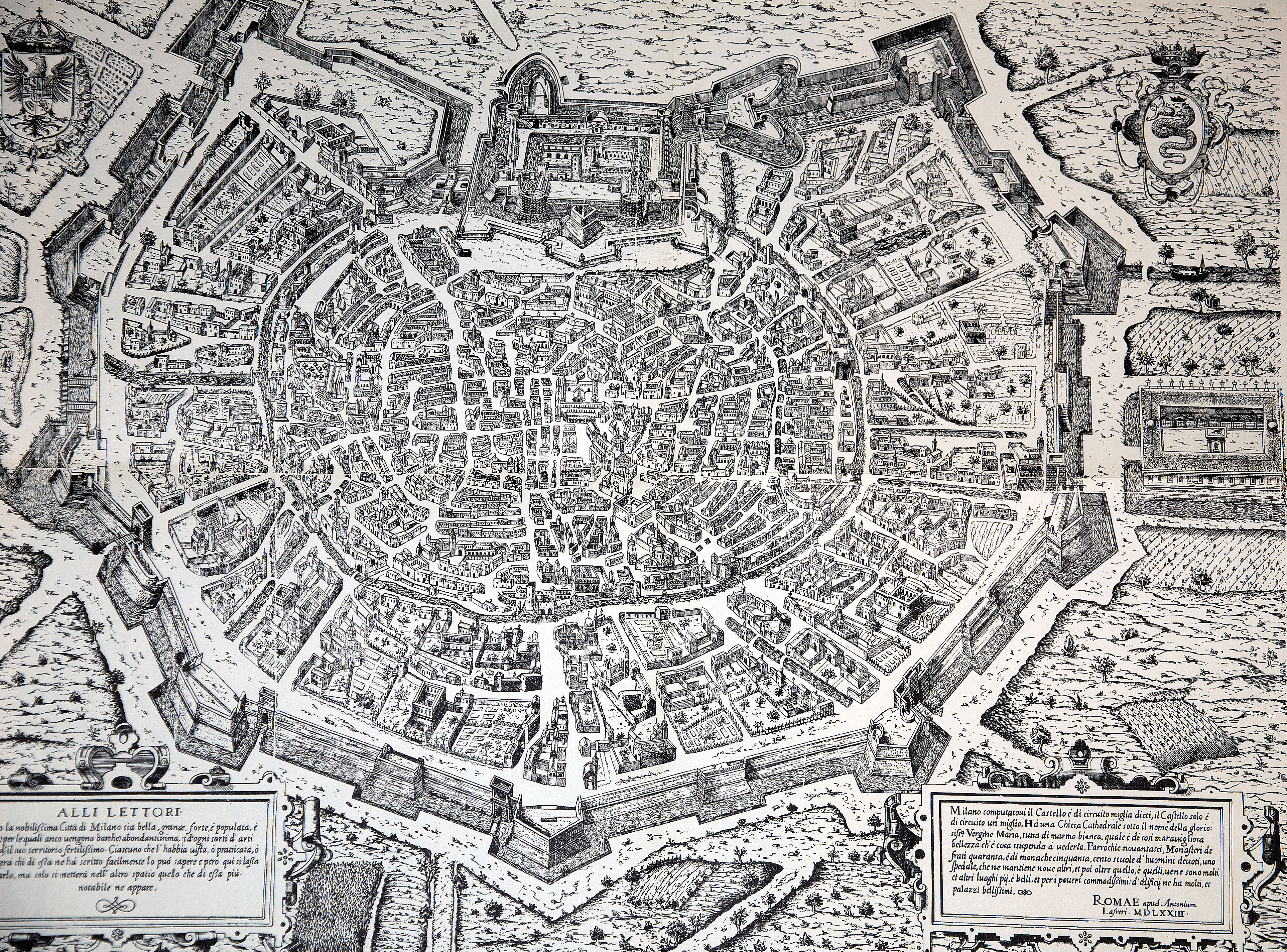
Between the 16th century and 19th Centuries France, Spain and Austria conquered Milan, building many Bastions that started eroding the little vegetation Milan was trying to preserve. 
Milan in 1573. Image from wikipedia

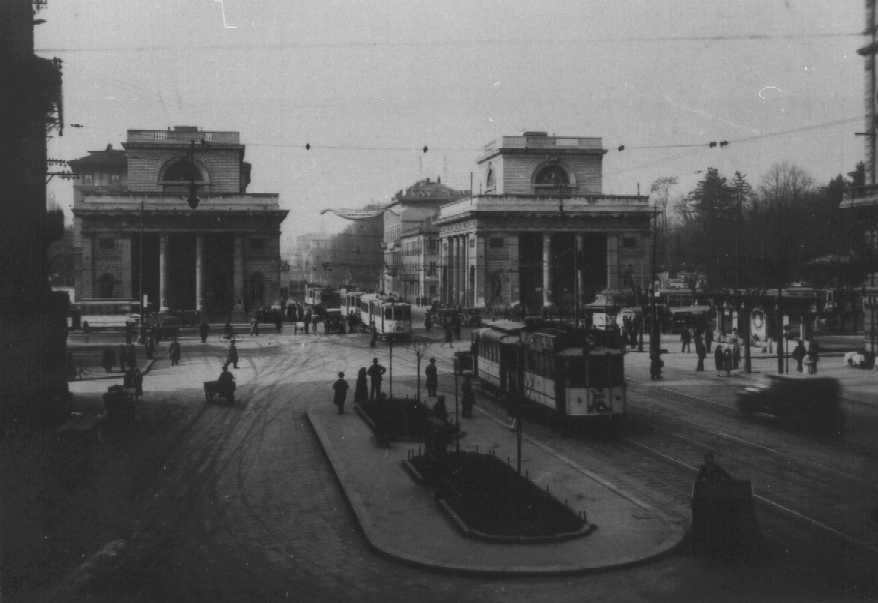
The Bastions, though, were beautiful, and Milanese started enjoying their presence. Once there was no more danger of invasions, the city kept the Bastions and turned them into passeggiate.

image from www.msacerdoti.it


The 20th Century saw Milan as the richest and most productive city in Italy. Not the biggest, even if many people from the south of Italy migrated here, looking for jobs. In 1943, during the Second World War, Milan was heavily bombed. Period.


Above, Galleria Vittorio Emanuele

Above, Santa Maria alle Grazie. This church still guests the Da Vinci's Last Supper 

Milan, together with the rest of Italy, got back on track as soon as possible. There was the economic boom in the 60s and the city grew even more. In the 80s, though, the production relented, and many industries relocated elsewhere. Milan slowed down, both economically and morally. These are the years of the Dolce Vita Milanese, and despite that sounds good now, the city didn't give its best.

After two decades of relative immobility, the New Millenium saw Milan getting a bit better, leading the industrial design sector, keeping the role of Italian fashion capital, and inventing the Happy Hour. The city, which has always a relatively poor weather, is still polluted, but less than in the past. 

Despite all the irony I put in this post, I think Milan is a truly precious city. I love it, so full of complex relation between old and new buildings. The density of the city is incredible, so full of overlapped details.
When I left the city in 2012, many of the buildings designed for the EXPO 2015 were under construction, including the famous Bosco Verticale by Stefano Boeri, voted the most beautiful highrise


Here you can see more photos I took in summer 2013. 


BEA'S RECOMMENDATIONS 

For Architecture lovers, I love these tours of the city (architecture).
The best events, daily (sorry, it's in Italian!)


Duomo di Milano and Galleria Vittorio Emanuele


Colonne di San Lorenzo and then Happy Hour in one of the many cafes

Triennale di Milano and Parco Sempione

Museo del Design alla Triennale di Milano


Teatro alla Scala and Via Manzoni


Stazione Centrale and Grattacielo Pirelli from the street

Castello Sforzesco and Museo del Castello Sforzesco

Galleria Vittorio Emanuele and Libreria Bocca


Every time I go back home, I try to see them all.
I will not recommend places to eat or drink, because once there, you'll figure out them yourself.
Have fun in Milan! But bring an umbrella, just in case... and some work to do when you are not enjoying the city.


Saturday, 25 October 2014

AIA PGH Design Awards

Last Thursday, October 23rd 2014, the Pittsburgh Architectural community gathered to celebrate  the "Good Design" with a Gala and Awards. The Pittsburgh Cultural Trust Building was full of people from the construction scene. Not only Architects, but also Contractors, Engineers, Sponsors, Builders. Everybody under the same roof, was celebrating the winners, and the city of Pittsburgh.

The AIA of Pittsburgh hosted the event and I was honored to help in setting part of the space. My personal contribution was the creation of a pretty big map of the Burgh, 12 by 12 feet, to welcome the visitors in the Young Architect Studio Competition area, focused on Pittsburgh Rivers. Scale 1"=500'.
In the same zone of the YASC competition, there was the photography exhibition "Along the Rivers", again centered on the Allegheny, Monongahela, and Ohio Rivers.
I helped in curating that as well, after the photos were selected by our jurors Ed Massery, Natalie Grandinetti, and Kevin Kunak.

I had the idea of such a map, and designed it. Tri-state Reprographics was very professional at printing the map and install it nicely. Despite the number of people that walked on it, and those who carefully looked for their house, the map still looked good after a month!


Here a shot from the opening night, before everybody arrived:


Below: people arriving on the 4th floor, during the September Gallery crawl in Downtown. 


Below, on the walls, some boards from the photo exhibition "Along the Rivers".


All the events, from the Gallery Crawl to the Design Awards and Gala, were really successful. On October 9th there was also a PechaKucha Night which registered a very high number of presences: 130 people! This PKN was volume 19th in Pittsburgh, organized by the AIA PGH together with the AIGA PGH

It was a month of celebration for the Pittsburgh Design Community.
Looking forward the next year. I will start thinking of something amazing pretty soon.


Google Car: beyond technology

Google Street View is certainly a powerful tool, for many different purposes. It allows us to explore places we've never been to, remember places we visited, or give us ideas for future travels.

Here I collected some views of places I find inspiring. Hopefully, one day I'll see them with my eyes.


Wednesday, 22 October 2014

Sou Fujimoto - notes from a lecture

As the weather gets colder, the Carnegie Mellon University Fall 2014 Lectures Serie  is a very nice alternative to outdoor activities. I am not saying this because of their heating system - like those people that would go shopping to the malls only for seeking cool AC over summer. 
I truly believe Fall is a cultural season: no better way to warm up your creativity than attending lectures.

Today I will do a little experiment on the last lecture I followed: Sou Fujimoto (October 20th) talking about his architecture. I took notes on my iPad. Here, I will post the notes, just slightly edited.
----------------------------------------------------------------------------------------------------------------------


Notes from the lecture 
"Between Nature and Architecture"

Sou's goal: create a living environment for people
Sou's obsession: How to integrate Nature in the Architecture

Sou was born in Hokkaìdo (a lot of nature) and moved to Tokyo (a lot of concrete and chaos)
Nevertheless, he perceives Tokyo not as a crazy city but as a comfortable city. Why?
Tokyo situation: ugly and artificial, but there is a similarity between Tokyo and the nature
Tokyo is made of a myriad of little things. It's a chaotic and "a full situation"
The result of this packed environment is "coziness" 
There are so many little details, that this scale give you a sense of comfort.
And in Tokyo, as in a forest, you can walk around freely, protected and hidden by all these details.
Plus, you can always find out something new, something different, as it happens in a forest.

Photo by Bea Spolidoro - Tokio 2008

Which is the relation between the artificial complexity and the natural complexity?
Sou feels he discovered it working with the scale and the density of the elements.
He looks for a <<nice interaction between architecture and nature>>


Serpentine Pavillion (2013) for the Serpentine Galleries

© Daniel Portilla

Simple  concept: it's a cloud out of a structural grid
The repetition of the line creates different densities, for a cloud effect
The structure creates small cubes: he added glass to walk or sit on it.
There is a plastic roof, transparent.
He got the inspiration from the first site visit, by seeing a tree without leaves.
Simple rules, good balance between simplicity and complexity
It's a multipurpose space with a cafe

He thought first of the concept: like a landscape where people can stay
Then: how you do it?! 
Grid and transparency
The structure has been done by a computer in London
But after the structure was ready, no one had idea of how the space actually was like
Then they did a model to find it out
Luckily, it looked nice
Crazy process

From the outside, at first you cannot understand the space
As you get closer, you understand it
Transparency depends in the density of the structure
And it keeps changing according to were you are, where you walk
it's an "organic changing" around you, based on an artificial structure
See the shadows too! They contribute to the cloud effect.

The scale is important when creating impressions
The light by night comes from the ground
It makes it floating...
Architecture, landscape, furniture, inside outside...
It's all about phenomenon


House NA


Similar strategy, but this is a private house!
He tried to find out the integration of different basic condition
It was for a young couple, on a small site
You cannot get big room on a small site
So you have to integrate the spaces and combine them
Stack them on different levels, to get different area (not rooms!)
You have one room, articulated on many levels
The house inside resemble the tiny streets of tokyo
And the density allows the diversity and the possibility of many living choices

You are like in a tridimensional and artificial forest
Then there is a lot of glass, it's transparent
He asked the clients if it was too open, but they didn't want walls, at all
There are some curtains, designed and layered out by the client
The curtains are at different distances from the glass
This gives different density and scale


Souk design - particles of light

image Sou Fujimoto

Only designed, never built, for a competition
1 mile long - everything is possible in the Middle East
8 towers  around 100 m high
There are many voids, to create the "cloud" effect and vibrancy
Big voids to create breaks and to feel the rhythm
There is natural ventilation, vertically
The geometry is made by small units (arches) in a grid, repeated
It is the same concept and system of the Serpentine Gallery pavillion
It's a shape like a bedouin tent
It's a crazy idea: brought from a smaller scale to an extreme scale

Then the competition stopped suddenly
The king said to stop right there, that's it
And that's the middle east
Anything is possible


Toilet in nature

image Sou Fujimoto


It's a real public toilet, in a small village, for a train station
They needed only one public toilet!
It's a very small project, minimal scale
It's just a toilet in a glazed box, all transparent
It is public, but the toilet is a private space!
How to integrate the public and the private need?
How to block the view? How to integrate the opposites?
Divide the spaces! There is a gigantic wall around
It has two boundaries: the fence around (opaque) and the glazed walls
So now you see, but no one can see you.
He integrated existing trees inside the fence
The fence technology is simple: just poles in the ground

Lots of people came to see the toilet
And kept coming. They were too many, for only one public toilet
So they had to do more toilets. But they did the chemicals
And they put them inside the fence, behind the glazed toilet...


House N

image Sou Fujimoto


Another project that works with the boundaries
It has three boundaries
Tree boxes, one inside the other, with openings on walls and ceilings
The definition of outside becomes ambiguous
He revisited the traditional Japanese house, with indoor/outdoor relation
Creating gradations of the walls: one or many?
An old couple lives here: they asked only for a flat floor
Flat conditions, but there is a different way to create a gradation
The biggest box is open and contains the garden. No glass there
Then there is the other two, where you live
From inside you see three layers of walls, but it's very open to the sky
Some areas are very hidden, others are very open.
Again, you choose, every time, what do to and "how"
Everything keeps changing, inside a built structure
Nature and city
It's a beautiful example of how to integrate inside and outside in architecture


University Library in Musashino


Images Sou Fujimoto

The university choose Sou's firm  because they were all young
They won the competition
The theme is the forest of books
Systematic space and well organized, to find books
But it's like walking in a forest
It's a place for the inspiration
You can be surprised by a special finding, or go straight to your section and book
How to integrate the different idea? Wild forest and a precise cataloguing system?
Book walls wraps like a spiral
If you stay in the center, you can see all the sections, through the openings
The spiral goes out to the outdoor spaces. 
You can potentially continue the spiral for future expansion.
It can grow. Just add a roof!
Polycarbonate, transparencies and skylights
Nice expectations
There is a cozy scale, of the books, but also the almost infinite one, of the concept of a spiral.
You can choose to read in a cozy corner, or just walk around the library, in an infinite way


L'arbre blanc


High rise building in Montpellier (France)
How the opposites can come together: another good example
How to find a new typology for a housing tower, respecting tradition?
Need to respect the mediterranean climate and culture, also

They proposed a crazy monster of balconies
Lots of balconies: old strategy, but modern idea
Intense way to go beyond the boundaries
It's both fundamental an old, but new
The balconies come from the Montpellier Tradition
But the structure is a magnificent spiral
It's an organic creature, or a tree

The "lifestyle" of the balcony is very important in Montpellier
People in the jury were very pleased to see this reinterpretation of a tradition
Will be done in 2018
They are selling the condos now
Wanna buy one?

Sunday, 27 April 2014

Four Stories to be seen

The YAF Young Architects Forum of Pittsburgh choose me to review an exhibition at the Heinz Architectural Center.

Check it out on the AIA Pittburgh website!


Sunday, 6 April 2014

Pecha Kucha #17 - Carnevale a Schignano

On Thursday April 3rd, Pecha Kucha Night was held again in Pittsburgh, for the 17th time. The hosts were AIA Pittsburgh and AIGA Pittsburgh. The location - very appropriate - was the Melwood Screening Room at the Pittsburgh Filmmakers.

I was the third to present, and this time (my fourth time!) I spoke about the Carnevale in Schignano. It was a mix of Italian Tradition, Culture, funny stories about a village, and lots of cousins.

Before publishing my slides, I just want to say that what you'll see in the slides is just a 30% of all the things will happen at the Carnevale. Nevertheless, it is a good introduction to a fascinating event, which is gaining more attention at a national level, in Italy.

Here my Pecha Kucha. Enjoy!

1) First the place: Schignano is my grandma’s village in the North of Italy, Lombardia, near Lake Como. I was born in Milan but spent half of each year there. It’s an old place, poor but fascinating. We have wonderful mountains, forests, fields…

 2) …we have George Clooney, weather permitting. Schignano is very close to Laglio, where he has a house, and we are very proud of him. We would put him out on a balcony, with the flowers, to attract tourists. But now the Carnevale. Our is not very famous, but old. It was founded in the 14th century!


3) It happens every year around February, before the Catholic Lent. The dates would slightly change every year. In Schignano it is like a parade of traditional characters. The public would watch from the sides of the streets, as the parade moves. It’s like a theater, without a fixed text. We mainly have two categories of characters:


4) il Bello, the goodlooking, represents the rich people of the village. Rich families used to play this role, since the costumes were expensive. They have wonderful masks carved in walnut wood, in a light color. Some masks are 100 years old, but people still carve them nowadays. They are really heavy, but wonderful.


5) the Bello has a colorful hat, with silk laces and ribbons, and full of mock flowers. They have many details sewed to their costumes, like glazed or plastic jewels, little dolls and they carry decorated umbrellas, to show their wealth. That’s what they do.


6) On the other side, the Brutto is the ugly one, representing poor people, and in particular the manual laborers coming home from abroad, during the winter. That was very typical of poor people: leaving the village for almost a year. Poor families played the Brutto. They usually have empty and broken luggage, to represent the fact that they had to leave the village for work. 


7) The Brutto wears shreds and smelly furs of dead animals, and ugly wooden masks. The mask is really scary, and it is sometimes colored with red on the lips. Which is even more scarier. With a nasty smile. This one is my 6 years old cousin, Federico. My family is a family of Brutt!


8) There is only one special character. It’s the ciocia, the poor wife of a rich Bello. It’s always performed by a man. She would shout out loud, in dialect, complaining about her miserable condition, dragged around by her husband  with a rope. Since ever, the best ciocia is this guy, called “the magic”. He is my uncle Domenico. 

9) The Carnevale in Schignano is full of noises: people would shout to encourage the characters. Then there is the music from the band and most important, the bells of the masks. The Bello has the rich “bronze”, out of bronze. These are very expensive, and when Carnevale was over, they were used for the real animals at pasture.


10) On the contrary, the poor Brutto has poor bells, out of iron or aluminum. They have a dumb sound, compared to the crystal clear one of the bronze. Again, the bells would be taken on and off from the animals at pasture. They are wore with thick ropes around the waist. 


11) Carnevale in Schignano is very active. This is another cousin of mine, running after a Bello with a broken chair. This is part of the unwritten ply that happens every year: the tricks of the Brutt to the Belli. People would anyway prefer to be a Brutt, even if they become rich, because it’s funnier to be a Brutt. 


12) Brutt have no respect for anyone. They would stop cars, laying on them, or grab the people and touch them in the face, usually with the smelly skins of the dead animals or getting you dirty with only God knows what, and wine. Your first time at the Carnevale could be really upsetting, if you are not ready. 


13) This is the antique dealer of the village, and he has always the most amazing objects. Poor people would show up with broken old tools, usually working tools like sweeps, rakes, shovel. Here you see the gerla, which is a backpack made of crossed sticks. 


14) The Bello would go around the parade walking slowly, and showing off his costume. They are gently and elegant. My Grandma is one of the official tailors of these costumes. The waistcoat is full of dry leaves, collected new every year. She would fix the costumes, and sew the pants.


15) The fabrics are very colorful, some are very old. After getting dressed, you would add all the details, like the jewelry and the wonderful needlework. Many have very old umbrellas, symbol of wealth, or precious fans.The stick as well is pretty important and equally decorated. It is used to keep the Brutt away.


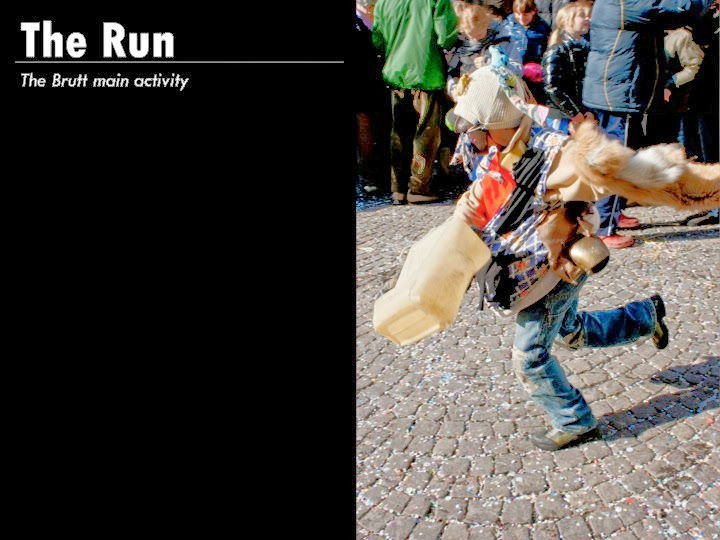
16) The Brutto would go around in a slovenly way, running like a mad, covered with rags and furs. Running is their main activity, to make the ciocche sound louder. Plus they would jump on you, trying to show off as well their stuff, even if it is poor and disgusting.


17) Since all the running is very tiring, they would suddenly and randomly stop, to rest. Anywhere! On the walls, in the middle of the street… they really look dead, or injured. They are usually just drunk, since people would drink for days, to best perform.


18) But the rest is really the Brutt second activity, apart from fooling around. People who see the Carnevale for the first time would think they fainted, or that they are not feeling well. As they get closer, the Brutto would jump as a cricket, push them, and run away.


19) But the best of the Carnevale in Schignano is that under many mask you see plenty of young kids, boys and girls, and they are the strength of the event. Fathers and Grandfather are very proud. Who is not dressed, knows the mask by heart, and the kids are always safe.


20) But I want to end my presentation with Chiara, half Italy and half Capoverde, who is a friend of mine. She is the best part of the Carnevale in Schignano, showing that the best traditions must renew and include everyone. 

the official website http://carnevaledischignano.it/
(Italian)

All my photos about the Carnevale

A project that you can help:
An entire book about the Carnevale in Schignano!
(English)